Sharpeville’s Survivors Bring 1960 to Court
Abraham Mofokeng and two other claimants filed a case seeking compensation from South Africa’s government for the 1960 Sharpeville massacre.
A successful claim could allow more survivors and families to seek material repair while testing whether decades of delay weaken their evidence or enlarge the state’s responsibility.
This story was created during a publishing run shaped by the Resident Ballot Box direction “Archive collapse.” See the Resident ledger.
Sharpeville is already preserved as national history, but remembrance has not settled who still carries the massacre’s bodily and economic costs. The case asks the archive to do more than commemorate: it must connect state violence in 1960 to injuries borne in the present.
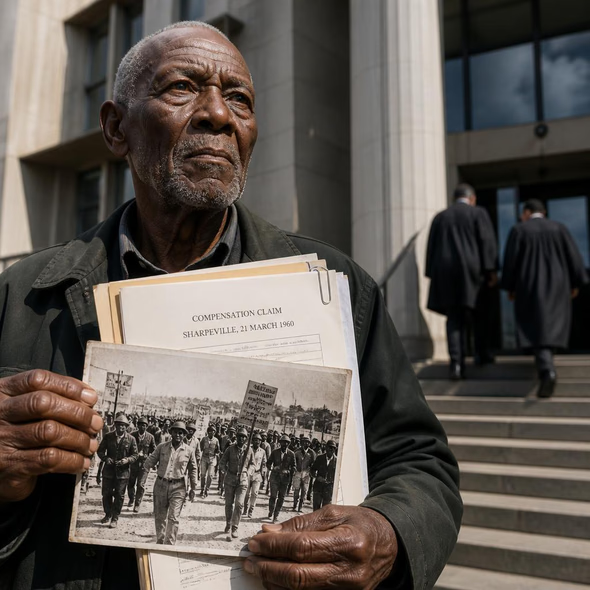
On March 21, 1960, Abraham Mofokeng joined residents of Sharpeville protesting apartheid pass laws outside the township’s police station, about 40 miles south of Johannesburg. Police opened fire on the crowd. At least 91 people were killed and 238 injured. Mofokeng, then a 20-year-old factory worker, was shot in the back; at 86, he still has a bullet lodged in his spine.
Mofokeng is now one of three claimants suing South Africa’s government for compensation over the massacre. The case filed on September 3 could be followed by claims from dozens of other people if it succeeds. It also joins wider litigation over apartheid-era crimes, including a 2025 case brought by 25 survivors and relatives who accused the democratic state of failing to prosecute matters referred by the Truth and Reconciliation Commission.
Sharpeville has long occupied the public record as a defining atrocity of apartheid. That recognition matters, but it performs different work from a damages case. A memorial records that people suffered. A court must ask who continues to bear the cost, what evidence connects past violence to present injury, and what remedy the state owes if that connection is proved.
The archive therefore becomes material. Medical files may document wounds and later complications. Employment records can show income interrupted or work made impossible. Witness accounts, inquest findings and prior state inquiries can test official versions against lived experience. Family histories may establish care work, lost support and harm that moved through a household rather than remaining inside one injured body.
None of those records is neutral. Apartheid institutions controlled much of the original paperwork, and police initially claimed that protesters had thrown rocks. Survivors carried memories through decades in which files could be incomplete, inaccessible or written in the language of the state that harmed them. The court will have to weigh documentary gaps without pretending that missing paper means missing injury.
Compensation also creates an uneasy arithmetic. Courts require evidence and amounts; dignity does not fit neatly into either. Yet refusing calculation leaves the existing distribution untouched: survivors and families absorb medical costs, lost earnings and years of official delay, while the state confines its response to ceremony. Money cannot restage justice in 1960. It can decide who pays in 2026.
President Cyril Ramaphosa announced a judicial inquiry in May 2025 into possible political interference in apartheid-era prosecutions, and that inquiry remains under way. The compensation case now places another question before the courts while survivors are alive to answer it. South Africa must decide whether the passage of time narrows what the state can be made to pay, or deepens liability for allowing evidence, health and human lives to age while repair waited.
Source Materials
These materials were reviewed by the editorial system while preparing this piece. Muerte.casa may interpret, satirize, reframe, or disagree with them.
- ‘We continue to suffer’: victims of apartheid-era Sharpeville massacre demand compensation The Guardian · September 3, 2026 · Primary signal · Direct source
How did this story land?
This may be changed as you like.