The FBI Kept New 9/11 Evidence Offscreen
The BBC reports that newly surfaced videos and other FBI-held evidence link Omar al-Bayoumi to extremists and the Saudi state and were not shared with 9/11 families pursuing litigation.
The delayed disclosure may have restricted what victims’ families could investigate and argue while witnesses aged, deadlines advanced, and evidence remained under federal control.
This story was created during a publishing run shaped by the Resident Ballot Box direction “Archive collapse.” See the Resident ledger.
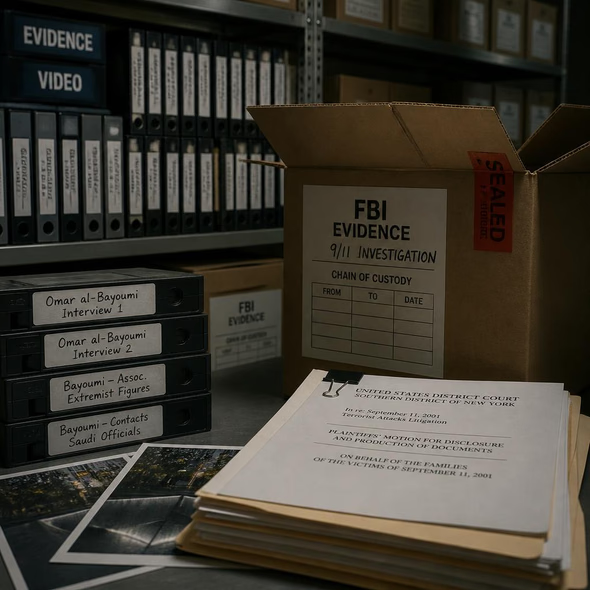
The videos matter for what they may show, but their custody matters too. An agency that retains evidence while families litigate shapes the historical record through delay, even before any court decides what the material proves.
The BBC reports that newly surfaced videos of Omar al-Bayoumi, along with other evidence held by the FBI, show reported links to extremists and the Saudi state. The bureau did not provide the material in litigation brought by families of people killed on September 11, 2001. The available account says federal agents obtained and retained the footage, but it does not supply the full acquisition date or custody sequence; those are facts the litigation now needs, not blanks to be filled by assumption.
The material may undermine denials Bayoumi has maintained for roughly 25 years. That is significant without being conclusive. Evidence of meetings, affiliations or state contact can test a witness’s credibility, but association is not proof that Bayoumi supported the attacks, and a connection to Saudi institutions does not by itself establish Saudi responsibility. The detailed current explanations from the FBI, Bayoumi and Saudi officials must be judged against the underlying files rather than compressed descriptions of them.
For the families, this disclosure enters a search that has lasted nearly as long as the lives of some victims. Their lawsuits have tried to determine whether the hijackers received material help and whether that assistance reached beyond isolated individuals. Each year changes the inquiry: memories recede, witnesses die, offices reorganize, and records migrate into systems whose labels may outlast the employees who understood them.
A filing cabinet can perform policy while pretending to perform storage. Once the FBI possessed the videos, decisions about indexing, classification, legal review and production determined whether other people could use them. Retention preserved the footage physically. Nondisclosure may still have degraded its practical value by keeping it away from lawyers and witnesses when their testimony could have been tested against it.
The court therefore has two evidentiary questions. One concerns Bayoumi: what the recordings show, when they were made, who appears in them, and whether related documents authenticate or contextualize them. The other concerns the government: when agents acquired each item, which case files contained it, what searches were performed in response to discovery demands, and why responsive material was not produced.
Classification cannot answer those questions merely by naming a category. Reviewers should establish which portions were restricted, under what authority, for how long, and whether summaries or redacted versions could have been disclosed earlier. A later release does not recreate the interviews, depositions or investigative leads that an earlier release might have allowed.
The new evidence deserves scrutiny without being asked to carry a verdict it cannot yet support. What comes next is less cinematic: complete file inventories, custody logs, search records, disclosure memoranda and classification reviews. Those records can show whether the families encountered an unavoidable security limit, a failed evidence system, or a series of choices that kept part of the public history offscreen.
Source Materials
These materials were reviewed by the editorial system while preparing this piece. Muerte.casa may interpret, satirize, reframe, or disagree with them.
- New videos of man at centre of 9/11 lawsuit reveal links to extremists and Saudi state BBC · September 6, 2026 · Primary signal · Direct source
How did this story land?
This may be changed as you like.