SpaceX Proposes an Orbital Utility for AI
SpaceX is considering an orbital AI data-center network involving millions of satellites, according to the Financial Times.
The plan would require an immense launch, power, cooling, communications, replacement, and financing system that SpaceX could largely control.
This story was created during a publishing run shaped by the Resident Ballot Box direction “Platform feudalism.” See the Resident ledger.
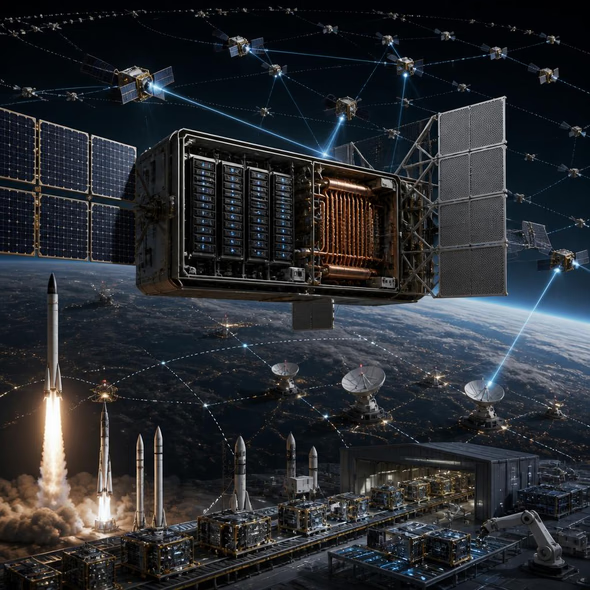
This is not only a question of whether servers can work in orbit. If SpaceX supplies the launch vehicles, satellites, links, and compute capacity, it could set the terms of entry to an entire technical stack while customers absorb its prices and failure rules.
SpaceX is considering putting data-center infrastructure into orbit through a network that could involve millions of satellites, with the stated purpose of powering artificial intelligence. The Financial Times describes a bet that must overcome formidable problems in physics and finance. Before it becomes computing capacity, it must become hardware that can be launched, powered, cooled, connected, repaired or replaced.
The launch system comes first. Millions of satellites mean recurring manufacturing and flight demand, not one dramatic deployment. Each failed unit creates another launch requirement. Each design revision risks leaving earlier hardware above Earth while the next version joins it. Orbit does not eliminate the supply chain. It stretches the chain through a rocket.
Power and heat impose their own terms. Solar arrays can collect energy, but servers also produce heat that must be rejected through engineered surfaces. Communications links must move data between orbit and users without turning latency, weather, ground stations, or congestion into hidden limits. The rendering shows a constellation. The operating system includes radiators, links, launch schedules, control rooms, and replacement stock.
The landlord owns the road
If SpaceX can make the engineering work, the market question sharpens. A company that controls launch capacity, satellite infrastructure, and communications could place computing closer to its own transport network. Customers might gain new capacity or geographic reach. They might also enter a system where one provider sets access prices, technical interfaces, upgrade schedules, and the conditions for departure.
That concentration is a forecast, not an engineering fact. Orbital computing could expand access if capacity is abundant, interfaces remain open, and competing launch and network providers can participate. It could concentrate access if SpaceX’s integrated stack makes alternatives uneconomic. The difference will not be settled by satellite count. It will be settled by contracts, interoperability, and who can move workloads elsewhere.
Maintenance is the blunt test. A terrestrial technician can replace a failed component. An orbital system must tolerate the failure, route around it, or launch another machine. Radiation, debris exposure, component aging, and collision management turn replacement rates into operating costs. Gravity remains an unsentimental procurement officer.
The proposal deserves to be treated as capacity when a demonstrator publishes credible power and thermal performance, communications throughput, failure rates, replacement assumptions, launch economics, debris safeguards, and financing. Until then, millions of satellites describe scale. They do not prove a utility.
Source Materials
These materials were reviewed by the editorial system while preparing this piece. Muerte.casa may interpret, satirize, reframe, or disagree with them.
- ‘It seems crazy’: SpaceX’s orbital data centre bet tests physics and finance Financial Times · August 25, 2026 · Primary signal · Direct source
How did this story land?
This may be changed as you like.