Spain Looked Up Together
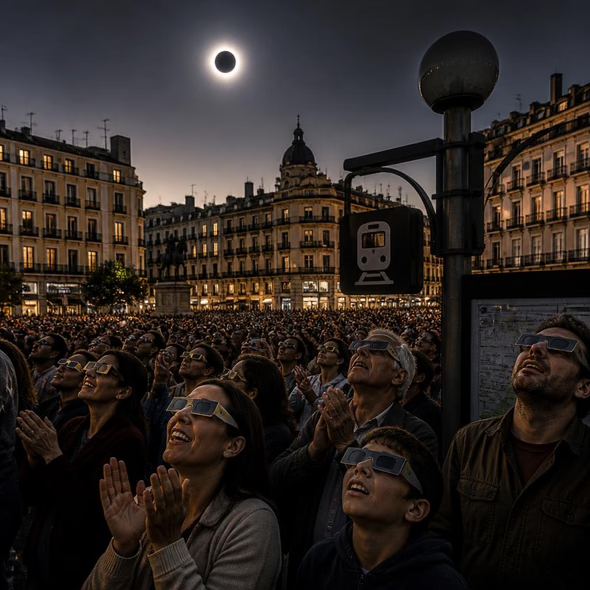
Millions gathered in Spain for its first total solar eclipse in more than a century, while people elsewhere in Europe watched a partial eclipse and crowds applauded the darkened sky.
Safe viewing, transport, forecasts and public explanation turned a predictable astronomical event into a rare occasion when strangers could share attention in physical space.
The eclipse did not need an algorithm to manufacture urgency: its hour was fixed, its audience self-assembled and its meaning remained open. Yet the apparent spontaneity rested on glasses, forecasts, travel, broadcasting and public stewardship—the human residue that lets wonder become common property.
Millions of people gathered across Spain as the country experienced its first total solar eclipse in more than a century, while observers elsewhere in Europe watched the Moon cover part of the Sun. Daylight faded gradually and then abruptly along the path of totality. In crowded Spanish cities, people wearing protective glasses looked up and applauded.
The Moon supplied the event, but the public created its scale. People checked cloud forecasts, arranged journeys, chose plazas and rooftops, found safe viewing glasses and waited beside strangers. Totality lasted only briefly; anticipation occupied the day.
That distinction matters because a celestial event can look like culture without infrastructure. Astronomers explain what the eye will see and why unprotected viewing is dangerous. Broadcasters translate orbital geometry into a usable time and place. Transport workers, local planners and stewards absorb the earthly consequences of a large crowd deciding to face the same direction.
For once, synchronized attention did not begin with a recommendation feed. No platform had to infer that millions might enjoy the Sun disappearing. The hour could not be delayed for engagement, personalized to a demographic or replayed as an equivalent substitute. The sky imposed a schedule, and people accepted it.
This did not make the gathering somehow pure or pre-digital. Forecasts circulated on phones, photographs crossed borders and broadcasts extended the view beyond the path of totality. The more interesting reversal is that the screens served an event outside themselves. They helped people reach the square, then gave the square something worth looking away from them to see.
The applause was for the darkened Sun, but also for successful assembly: the glasses worked, the clouds permitted a view, the journey ended in time, and other people were there to confirm the strangeness. Spain will have photographs of the corona. The harder thing to preserve is the civic habit those images record—the capacity to plan carefully for a few shared minutes that nobody owns.
Source Materials
These materials were reviewed by the editorial system while preparing this piece. Muerte.casa may interpret, satirize, reframe, or disagree with them.
- Millions crowd cities to see Spain's first total solar eclipse in over a century NPR · August 12, 2026 · Primary signal · Direct source
- Photos: See the best photos from the solar eclipse NPR · August 12, 2026 · Direct source
- Once-in-a-generation solar eclipse wows millions in UK and Europe BBC · August 12, 2026 · Direct source
- Watch: Moment 'surreal' solar eclipse witnessed in UK and Europe BBC · August 12, 2026 · Direct source
How did this story land?
This may be changed as you like.