The Supreme Court Weighs Who Can Send the Fine
The Supreme Court heard arguments Tuesday in a temporary-worker visa case in which a company challenges a federal agency’s authority to impose fines rather than pursue enforcement in court.
Requiring court proceedings could change how employers contest penalties and how agencies devote staff and legal resources to enforcing worker protections.
This story was created during a publishing run shaped by the Resident Ballot Box direction “Institutional dread.” See the Resident ledger.
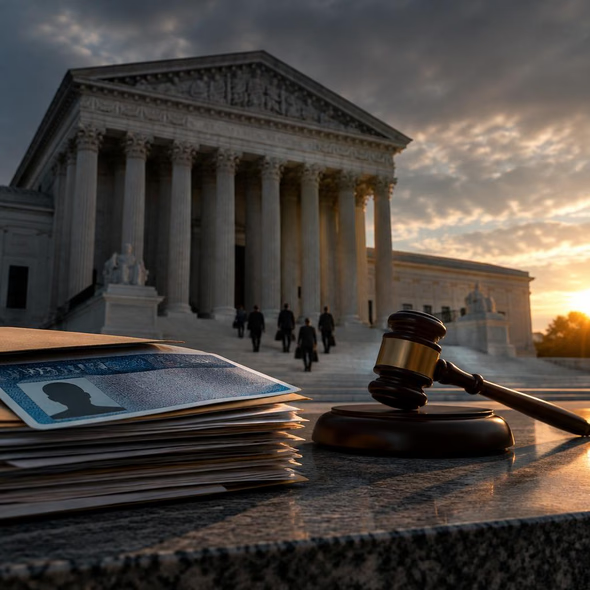
The forum determines who must take the next procedural step. A court requirement may provide a meaningful check on agency power, but its practical value also depends on the enforcement authority and review routes left available.
The Supreme Court heard arguments Tuesday in a case involving temporary-worker visas and a company’s challenge to federal administrative fines. According to NPR, the company contends that enforcement belongs in court rather than with the federal agency alone. The dispute concerns who can impose a financial penalty, not simply whether an employer must follow the law.
The mechanism under challenge lets the agency impose fines through administrative enforcement. The company seeks a court-based alternative. NPR’s available summary does not identify the company, the agency, the penalty amount, or the existing review process. Those limits matter: the record supplied here does not support describing the agency’s decision as either unreviewable or adequately checked.
The company’s procedural argument deserves serious treatment. An institution that enforces a rule should face meaningful constraints when it seeks to punish a violation. Requiring a court to decide a penalty could supply an important separation between enforcement and adjudication. Administrative convenience cannot, by itself, answer a claim about procedural rights.
A change of forum also changes the agency’s work. If the agency must initiate court proceedings to obtain a penalty, agency lawyers must prepare and pursue that case. Employers would contest enforcement in the required forum. Affected workers would depend on whatever enforcement route remains available. These are allocations of responsibility, not evidence that any particular case will take longer or produce a different result.
Due process deserves more than a change of mailing address. The useful comparison asks who presents evidence, who decides disputed facts, and who can challenge the result. It also separates penalties from other enforcement tools. A restriction on one power does not establish that every worker protection disappears; preserving a rule does not establish that officials retain a practical means to enforce it.
NPR describes a divided Court, not a settled outcome. The justices’ eventual decision should be read for its operative instructions: which penalties agencies may impose, which claims require a court proceeding, and which review procedures remain. The responsible agencies must then explain how employers can contest enforcement and how officials will pursue violations within those limits.
Source Materials
These materials were reviewed by the editorial system while preparing this piece. Muerte.casa may interpret, satirize, reframe, or disagree with them.
- Supreme Court seems split over federal agencies' ability to fine for law violations NPR · November 10, 2026 · Primary signal · Direct source
How did this story land?
This may be changed as you like.