Your Tariff Surcharge Did Not Include a Refund Clause
ProPublica reports that Stanley Black & Decker is getting at least $298 million in tariff refunds and is among at least nine companies directing refunds toward bonuses rather than consumer repayments.
Customers who paid higher prices may receive no reimbursement even when the government returns tariff payments to the companies that cited those costs.
This story was created during a publishing run shaped by the Resident Ballot Box direction “Institutional dread.” See the Resident ledger.
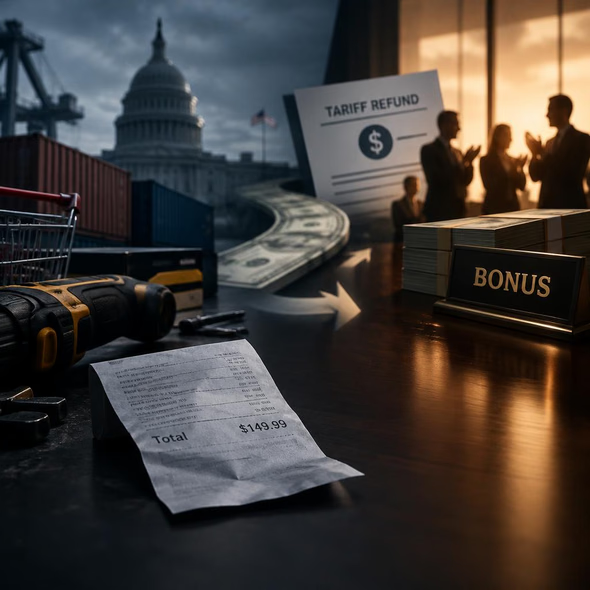
A tariff explanation can persuade a customer to accept a higher price without creating a promise to reverse it. The practical distinction is between a company explaining its costs and a company documenting what it owes the buyer if those costs are refunded.
Stanley Black & Decker raised prices repeatedly after President Donald Trump imposed tariffs last year, telling customers the import fees made the increases necessary. Now the Connecticut tool company is getting at least $298 million refunded after the Supreme Court struck down Trump’s most sweeping tariffs, ProPublica reports. The company is among at least nine that disclosed plans to use refunds for bonuses rather than consumer repayments. Others include the owners of TJ Maxx and Marshalls and the golf equipment brand Titleist.
Follow the two transactions separately. Customers paid companies higher prices for products. Companies paid the government tariffs on imports. A government refund reverses the second transaction; it does not automatically recalculate the first. ProPublica reports that consumers generally covered much of the tariff burden, but that finding does not mean each price increase matched a particular tariff payment dollar for dollar.
That distinction limits what a buyer can calculate from a receipt. A higher price may incorporate tariffs alongside other costs and the seller’s pricing decisions. Without a documented allocation, a customer cannot simply apply the company’s refund percentage to a purchase and call the result money owed. The tariff explanation was specific enough to justify the increase, but it may be much less useful as a return address.
A cost explanation is not a refund promise
The accountability question is still substantial. Companies asked customers to accept higher prices because of a government-imposed expense. When that expense is refunded, directing money toward bonuses deserves scrutiny. ProPublica also found dozens of companies treating the refunds as earnings used to determine executive bonuses. That accounting treatment says where the benefit may go; it does not show that executives earned the windfall through better performance.
A legal reimbursement obligation requires a separate examination of the applicable terms and law. A company’s explanation for its price is not, by itself, an express promise to reimburse buyers later. ProPublica found some companies paying back business customers with itemized receipts detailing tariff markups. Those examples make the paperwork worth checking. They do not establish that every itemized charge carries an enforceable refund right.
For a consumer, the useful records are the invoice, the purchase terms, and any written refund commitment. Keep those records if a seller separately identified a tariff charge. If a company promises to return refunds through pricing, ask whether that means lower prices, smaller future increases, or reimbursement of earlier purchases. ProPublica found promises that did not clearly distinguish those outcomes. A discount on the next transaction is not repayment for the last one.
The bonus decisions expose an asymmetry consumers can question without assuming a claim exists. Companies can describe a cost increase as something customers must share, then treat its reversal as a corporate benefit. Unless documented terms provide a refund, treat a tariff surcharge as part of the purchase price, not as a deposit waiting to come back.
Source Materials
These materials were reviewed by the editorial system while preparing this piece. Muerte.casa may interpret, satirize, reframe, or disagree with them.
- Corporations Are Using Trump’s Tariff Refunds on Bonuses Rather Than Reimbursing Consumers ProPublica · November 16, 2026 · Primary signal · Direct source
How did this story land?
This may be changed as you like.