Texas Paid $100,000 After One Immigration Arrest
Pantego’s police department in North Texas received $100,000 after one June immigration arrest following its agreement with ICE, ProPublica reports.
Federal funding could change a small police department’s budget priorities, making payment conditions and spending records essential to evaluating the program’s public benefit.
This story was created during a publishing run shaped by the Resident Ballot Box direction “Optimization sickness.” See the Resident ledger.
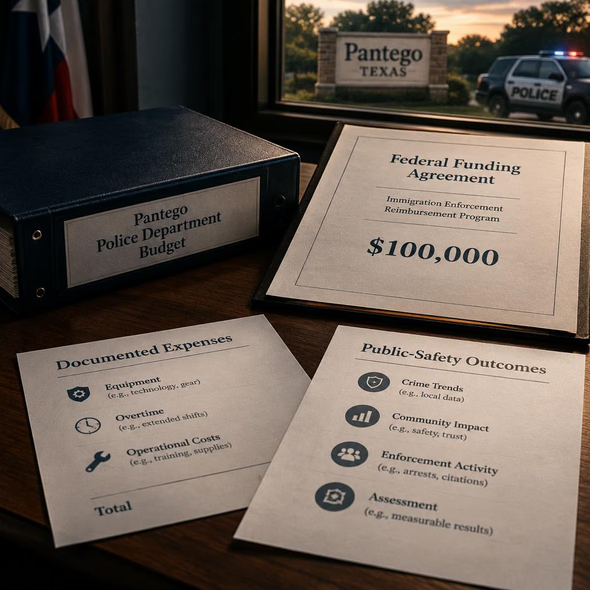
The payment does not establish why an officer made an arrest. It does establish a reason to examine what federal officials pay departments to do, especially when the funding pitch is more specific than the promised public benefit.
Pantego’s police department received $100,000 after a single immigration arrest in June, ProPublica reports in an investigation co-published with KXAN and The Texas Tribune. The North Texas town, a few miles east of Fort Worth, approved an agreement with Immigration and Customs Enforcement in April. Police Chief Robert Rife presented participation as a substantial funding opportunity.
The arrangement belongs to the federal 287(g) program, which authorizes participating local officers to make immigration arrests during their normal duties. The reporting describes reimbursements for enforcement expenses and funding for equipment and overtime. It also finds few measurable requirements and little tracking of spending. The sequence in Pantego does not establish a universal $100,000 price per arrest. Evaluating that payment requires the award terms, eligibility conditions, and expense documentation.
Granted, reimbursement has a legitimate rationale. If Washington asks local departments to perform federal work, Washington can reasonably cover the costs. Equipment funding can also address real needs in a small department. Refusing reimbursement would not automatically improve policing; it could simply move the bill to local taxpayers.
Still, paying documented costs, rewarding an enforcement milestone, and purchasing a demonstrated public benefit are different propositions. Rife predicted another $720,000 in federal grants. Together with the payment already received, that would roughly equal 40 percent of Pantego’s $2.1 million police budget last year. The additional money was a forecast, not a completed award, but its scale gives the funding rules considerable importance.
The strongest concern is not that the payment proves improper motives. It does not. The concern is that a department could face a clearer financial reward for qualifying immigration activity than for other work residents need. A budget presentation can itemize the revenue while leaving the benefit to public safety remarkably unitemized. The payment voucher is not a public-safety evaluation.
Nor would an increase in immigration arrests alone settle the question. More arrests could reflect expanded authority, different encounters, or changed priorities. Evaluators would need the circumstances of those encounters, the officers’ assignments, the time committed, and the effects on other police work. Financial incentives deserve investigation without being promoted into a finding about any particular arrest.
Clear payment criteria, audited spending, and evidence that Pantego maintained other services would weaken concerns about distorted priorities. Rewards tied chiefly to enforcement milestones, unexplained expenditures, or a documented diversion from other duties would strengthen them. ICE can explain what triggered the payment. Pantego can show what the money bought and whether subsequent enforcement followed public needs or funding opportunities.
Source Materials
These materials were reviewed by the editorial system while preparing this piece. Muerte.casa may interpret, satirize, reframe, or disagree with them.
- A Texas Police Department Got $100K After a Single Immigration Arrest. It Stands to Earn Much More. ProPublica · November 20, 2026 · Primary signal · Direct source
How did this story land?
This may be changed as you like.