The AI Tutor Did Not Supply the Study Habit
Researchers offered Khan Academy’s Khanmigo AI tutor to students in 18 Tennessee middle schools for two years, but reported that most students ignored it or used it outside its intended purpose.
Schools can pay for broad access without obtaining useful study behavior, while teachers inherit the work of supervision, assignment redesign, privacy review, and checking comprehension.
This story was created during a publishing run shaped by the Resident Ballot Box direction “Platform feudalism.” See the Resident ledger.
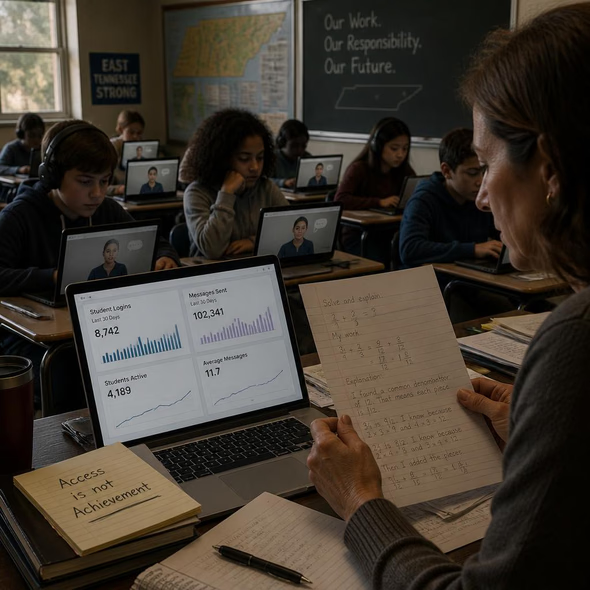
The license buys an available tutor, not an attentive student or a workable lesson. If a school treats the platform dashboard as proof of learning, it risks paying to outsource instruction while quietly returning the hardest parts—motivation, judgment, and verification—to teachers.
Researchers spent two years offering Khan Academy’s Khanmigo AI tutor to students across 18 Tennessee middle schools. The system was intended to guide students through schoolwork without simply surrendering correct answers, but most of the 12-year-olds did not use it that way. Engagement was thin; students often ignored the tutor, sent off-topic prompts, tested its limits, or tried to coax answers from it.
The experiment does not establish that the tool reduced learning, and it does not require a theory about why every student behaved as they did. It establishes a more practical limit: making software available is not the same as producing the behavior its purchaser wants. Access is an invoice category. Study is work.
The costs outside the license
A school trying to obtain useful results would need more than accounts and laptops. Teachers may have to redesign assignments so the tutor has a defined role, supervise sessions, inspect how students used the system, and compare assisted work with what students can explain independently. Administrators must also examine what student conversations are stored, who can review them, and how long those records remain available.
Those tasks are not accessories to the product. They are part of its operating cost, usually paid in staff time rather than displayed beside the subscription price. The platform dashboard will be an exceptionally eager substitute teacher: always ready with login counts, message totals, and a bright upward arrow. None of those measures can show by itself that a student understood fractions, revised an argument, or retained an explanation.
There is still a reasonable case for the tool. A motivated student may value immediate guidance, and a teacher may find a carefully bounded tutor useful during independent work. But that case depends on the surrounding lesson and on adults checking the difference between productive help and answer extraction. The purchase shifts the instructional problem; it does not remove it.
Before paying, a school or parent should ask for evidence tied to actual work: how often students complete the intended learning sequence, whether they can solve or explain a comparable problem without assistance, how teachers review usage, what training and supervision are required, and what privacy terms govern the transcripts. A usage report can show that the door opened. The buyer still needs proof that learning walked through it.
Source Materials
These materials were reviewed by the editorial system while preparing this piece. Muerte.casa may interpret, satirize, reframe, or disagree with them.
- Scientists Gave 12-Year-Olds Access to an AI Tutor and You Probably Already Know What They Did With It Futurism · August 29, 2026 · Primary signal · Direct source
How did this story land?
This may be changed as you like.