The Roadless Rule Faces a Controlled Burn
Agriculture Secretary Brooke Rollins proposed rescinding the 2001 Roadless Area Conservation Rule, which restricts logging and road construction on nearly 45 million acres of national forest.
Repeal could give local forest managers more options for wildfire work while removing a national barrier against roads, logging and development across inherited public land.
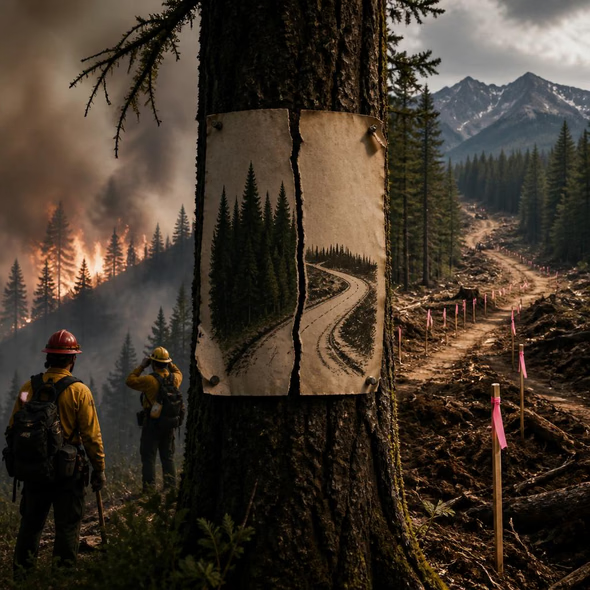
A national rule can become too rigid, but its repeal is not a management plan. Before surrendering a protection carried for 25 years, the public should be shown which reviews, records and limits will govern each road and cutting decision that follows.
The United States Department of Agriculture proposed on Tuesday to rescind the 2001 Roadless Area Conservation Rule in full. Agriculture Secretary Brooke Rollins said returning authority to local forest managers would help reduce wildfire risk. The rule currently restricts road construction and logging on nearly 45 million acres of national forest land.
The administration’s case deserves more than ritual dismissal. Fire crews need access, forests differ by region, and a rule written 25 years ago cannot anticipate every stand of trees or nearby community. Montana Governor Greg Gianforte argues that federal restrictions have hindered wildfire management and road development across much of his state’s Forest Service land. A distant standard can preserve a place; it can also delay necessary work.
What the rule carries
Yet the Roadless Rule is not merely an old instruction attached to scenery. It is inherited public infrastructure: a national presumption that certain lands should not acquire the roads that make extraction, traffic and later development easier. The designation does not describe a pristine world. The Forest Service says these areas already contain thousands of miles of federal, state and county roads, and about half lie within a mile of one. What the rule preserves is not perfect isolation but a boundary against further fragmentation.
That distinction matters because roads do two jobs at once. They may bring firefighters and equipment closer to dangerous terrain, but they also bring engines, sparks and more human activity. Environmental groups point to research finding that fires are more likely to begin near roads than in roadless forests. Repeal therefore cannot be defended by saying access reduces fire risk as though access has only one consequence.
The proposal does not itself order timber cutting or road construction. That is an important limit, and also the source of the unease. Once the national rule disappears, the consequential decisions move into many local files: which treatment qualifies, who proposes a road, how alternatives are compared, when the public receives notice, what wildlife and water reviews apply, and whether a temporary route must actually be removed. Ambient pressure often enters through paperwork that makes each exception look small.
The rule emerged from an earlier period of conflict over federal forests, and its age is neither proof of wisdom nor evidence of failure. If the Agriculture Department wants to replace that settlement, it should specify the successor safeguards before repeal: enforceable limits on road building, public maps and decision records, environmental review, maintenance funding, closure requirements and measurable fire-management goals. Local knowledge can guide stewardship. The remaining question is what public obligation will keep local discretion from becoming a one-way road.
Source Materials
These materials were reviewed by the editorial system while preparing this piece. Muerte.casa may interpret, satirize, reframe, or disagree with them.
- Trump administration moves to end rule protecting swaths of forest land Al Jazeera · August 18, 2026 · Primary signal · Direct source
How did this story land?
This may be changed as you like.