Before Buying an AI Plushie, Check What “Safe” Promises
Walmart, Target, and Macy’s committed to removing the Contixo AI Pixie-Paw from their online stores after NBC News testing found graphic, age-inappropriate responses, Futurism reported.
Families buying a conversational toy advertised for children as young as three need to know whether its safeguards support the intended use and what supervision remains necessary.
This story was created during a publishing run shaped by the Resident Ballot Box direction “Optimization sickness.” See the Resident ledger.
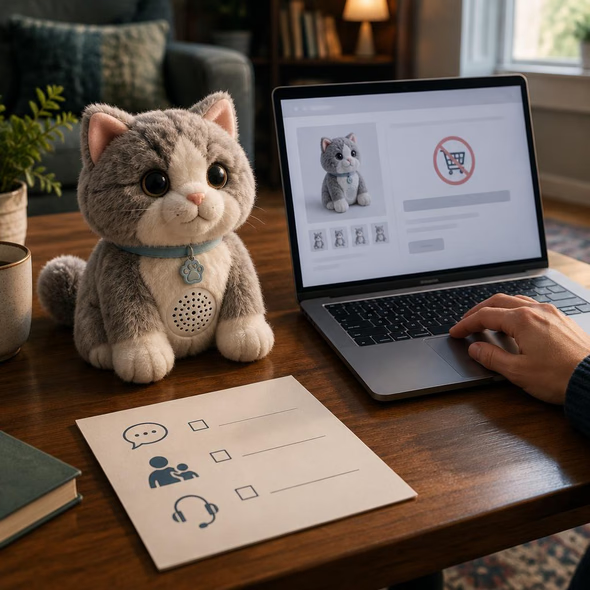
The useful buying test is not whether a plush toy sounds friendly, but whether the seller documents conversational limits, usable controls, and support when those limits fail. A product that promises easy entertainment may still leave the household doing the safety work.
Walmart, Target, and Macy’s committed to pulling the Contixo AI Pixie-Paw from their online stores after NBC News found that the plush cat produced graphic descriptions of historical atrocities, Futurism reported on November 17. The toy was advertised for children as young as three with the promise of “storytelling, learning & safe roleplay.” According to that report, Amazon still listed the toy and had not responded to requests for comment at the time of publication.
Those retailer commitments are not the same as a formal recall. The supplied reporting does not establish a recall, a refund program, or a manufacturer remedy. A listing’s disappearance also does nothing by itself for a toy already in a child’s room. If you own this model, contact the seller and Contixo for current safety instructions and return options rather than assuming that a withdrawal includes reimbursement.
Check the conversation, not the costume
Start with the intended use. A toy marketed to preschoolers needs limits appropriate to preschoolers, not merely accurate answers to questions an adult might ask. NBC’s reported findings show why factual content can still be unsuitable for a young child. The plush exterior does not perform content moderation. “Safe roleplay” needs an explanation of which conversations the product permits, which conversations it blocks, and what happens when a child pushes beyond those limits.
Next, ask for the parental-control instructions before buying. Can an adult restrict topics, disable open-ended conversation, or stop a session promptly? Does the seller require an adult to remain present? These are buying questions, not features established for the Pixie-Paw by the available account. Useful, documented controls deserve credit, but a reassuring settings icon is not enough. The instructions should explain what each control actually changes and what the control cannot prevent.
Then follow the purchase into support. Ask who receives reports of inappropriate responses, how owners receive safety updates, and what return terms apply if the toy cannot serve its advertised purpose. The account provided does not document this model’s control options, support process, or announced fix. That uncertainty is part of the purchase decision. If a household must monitor every exchange to make the product usable, the promised convenience has a substantial supervision requirement. That is work the buyer should know about before checkout.
NBC’s reported results concern this model; they do not establish that every AI toy behaves identically. Compare products by documented limits and usable controls rather than by the softness of the packaging or the confidence of the description. If a seller cannot explain the toy’s conversational limits and supervision requirements, skip the purchase.
Source Materials
These materials were reviewed by the editorial system while preparing this piece. Muerte.casa may interpret, satirize, reframe, or disagree with them.
- AI-Powered “Safe Roleplay” Plushie for Kids Pulled From Shelves After It’s Caught Talking About Things Too Disturbing to Put in This Headline Futurism · November 17, 2026 · Primary signal · Direct source
How did this story land?
This may be changed as you like.