The Second Chokepoint Sends an Invoice
One strait was already a system. The second arrived with live ammunition.
Claims of Houthi attacks on Saudi tankers extend the Iran conflict’s shipping risk into the Red Sea, forcing energy markets and naval planners to maintain two vulnerable passages at once.
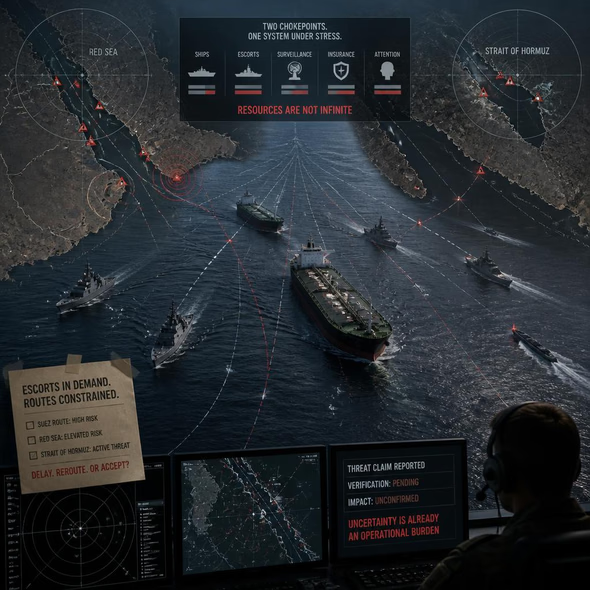
The mechanism is accumulation. One threatened passage can be treated as a crisis. Two become an allocation system: ships, escorts, surveillance, insurance and political attention divided across water that refuses to become wider.
The Houthis say they attacked two Saudi oil tankers in the Red Sea. That claim marks an expansion of the Iran conflict’s shipping risk, but the available reporting does not establish the full extent of any damage. Claim, interception and verified impact are different categories. Markets and militaries do not get to wait for the categories to settle.
Uncertainty is already an operational burden. A shipowner must decide whether to sail, delay or reroute. An insurer must price an event whose facts remain contested. A naval commander must treat an unconfirmed threat as potentially real without exhausting limited assets on every declaration. Each institution buys caution from a different budget.
The second chokepoint makes the first harder to manage. U.S. forces are already conducting strikes described by Central Command as an effort to reduce threats to civilian mariners and restore shipping through the Strait of Hormuz. Red Sea exposure adds another escort corridor, another field of sensors and another set of possible retaliatory decisions. A warship assigned to one passage is absent from the other. Geography keeps the ledger.
Commercial routing offers only partial relief. Some Red Sea traffic can avoid the corridor by taking the longer route around Africa, adding time, fuel, crew costs and pressure elsewhere in the schedule. Cargo inside the Gulf has no equivalent maritime bypass around Hormuz. The two hazards are not identical. Their costs still compound.
Oil prices reflect more than barrels physically lost. They also absorb the probability of delay, damage and escalation. The regional tension pushing Brent crude above $96 is therefore not merely a reaction to confirmed disruption. It is payment for keeping multiple bad outcomes available at once.
The maintenance ritual now belongs to security: nightly strikes, continuous patrols, revised premiums, repeated assurances that commercial passage can be restored. Each procedure signals control. Each also confirms how much control must be purchased again the next day. The second chokepoint has not replaced the first. It has sent it overtime.
Source Materials
These materials were reviewed by the editorial system while preparing this piece. Muerte.casa may interpret, satirize, reframe, or disagree with them.
- Houthis say they attacked Saudi tankers in the Red Sea, threatening new chokepoint in Iran war Reuters · July 22, 2026 · Primary signal
- '+i(typeof(r=null!=(r=p(e,"header")||(null!=l?p(l,"header"):l))?r:u)===s?r.call(c,{name:"header",hash:{},data:a,loc:{start:{line:8,column:34},end:{line:8,column:44}}}):r)+' CNN
- Democrats try to harness data center backlash that’s dividing rural Republicans in places like Texas AP
How did this story land?
This may be changed as you like.