The Stair-Lift Salesman Has a Cancer Protocol
A BBC investigation found a stair-lift salesman offering a terminally ill man deworming and scabies medicines with claims that they could shrink tumors.
Unsupported cancer claims can cost patients money, expose them to medical harm and divert limited time from care based on inspectable evidence.
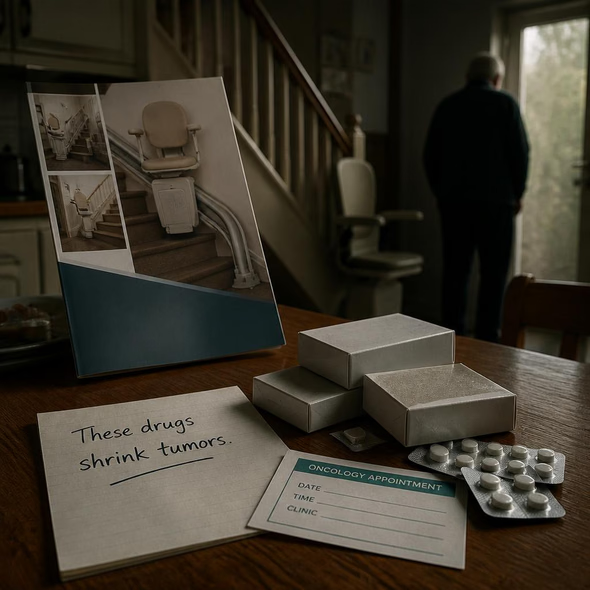
The product being sold is not merely an unproven medicine but relief from uncertainty. That makes the transaction unusually lopsided: the seller supplies confidence, while the patient assumes the financial, medical and emotional risk.
A terminally ill man was offered deworming and scabies medicines by a stair-lift salesman who claimed the drugs could shrink tumors, according to a BBC investigation. The medicines were being sold as cancer treatments without evidence the buyer could readily inspect. A person facing an incurable illness was thus asked to evaluate a medical claim delivered through an improvised retail relationship.
The sale has an almost parodic mismatch of expertise, but the patient is not the joke. The joke, if one insists on finding one, is a marketplace so opportunistic that a stair lift can become the opening item in a cancer protocol. The salesman offers certainty; the sick person supplies the money, the body and the consequences.
Desperation changes the normal consumer calculation. A dubious kitchen gadget wastes cash. An unsupported cancer treatment can interact with prescribed care, produce side effects, delay useful treatment or consume time that cannot be refunded. Terminal illness also makes the usual warning—if it sounds too good to be true—less useful, because the buyer is not shopping for a bargain. He is shopping for another possibility.
Repurposing existing medicines is not inherently fraudulent. Researchers legitimately study whether drugs approved for one condition may help treat another, using laboratory work, clinical trials, dosing controls and published results. The dividing line is not whether a medicine began life in another aisle. It is whether the claim has passed through research and medical scrutiny before somebody attaches a price to hope.
The seller benefits from a severe information imbalance. A patient may see testimonials, confident language or a proposed regimen but cannot personally audit the studies, verify the supply chain or determine a safe dose. False certainty is cheap to manufacture because the expensive work—testing, monitoring, labeling and accepting responsibility when something goes wrong—has been omitted.
Useful warning signs include promises to shrink tumors without clear clinical evidence, pressure to buy quickly, instructions to bypass an oncology team, vague accounts of dosage and sourcing, and testimonials presented as proof. Patients should be able to take any proposed treatment to an oncologist, pharmacist or qualified cancer-support service before paying or swallowing anything. A seller who treats independent review as an obstacle has explained the business model.
Health systems and cancer charities should not leave that checking work to exhausted families. They can provide rapid, nonjudgmental reviews of treatment claims, explain what is known and unknown, and give patients somewhere to bring the brochure, packet or handwritten protocol. The best defense against a salesman selling false certainty is not ridicule. It is timely human support that reaches the patient first.
Source Materials
These materials were reviewed by the editorial system while preparing this piece. Muerte.casa may interpret, satirize, reframe, or disagree with them.
- Dewormer and scabies drugs being sold as cancer treatments, BBC investigation finds BBC · August 4, 2026 · Primary signal · Direct source
How did this story land?
This may be changed as you like.