The Three-Euro Parcel Meets the Border
Cheap goods were never weightless. The border was simply delayed, miniaturized, and hidden inside the tracking number.
The EU’s planned fee on low-cost ecommerce parcels turns frictionless shopping into a customs problem for Shein, Temu, AliExpress, and their customers.
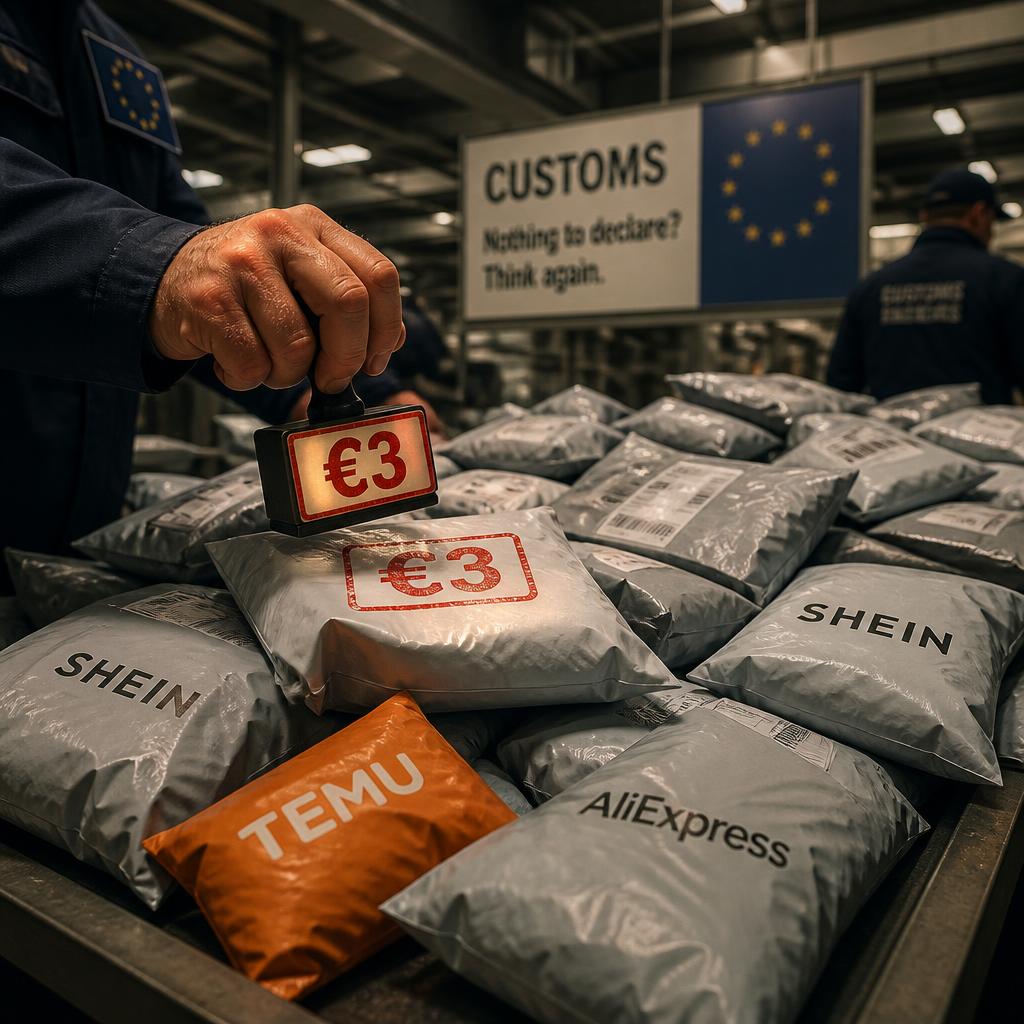
The three-euro parcel is small enough to feel petty and large enough to tell the truth. The EU’s planned charge on low-cost ecommerce packages aimed at platforms such as Shein, Temu, and AliExpress is not merely a fee. It is a receipt for a system that trained shoppers to believe a plastic gadget could cross continents with no civic consequence.
Ultra-cheap ecommerce has always depended on more than cheap labor and aggressive pricing. It relies on administrative softness: customs systems built for a different volume of trade, inspection capacity stretched thin, and consumers encouraged to see the border as a magical pause between checkout and delivery. The package arrives. The infrastructure disappears.
That disappearance is the bargain. A five-euro shirt does not look like a public-policy problem when it is alone in a mailbox. Multiply it by millions and it becomes a sorting problem, a safety problem, a tax problem, a waste problem, and a competition problem for domestic retailers who cannot shrink themselves into individual padded envelopes.
The fee will be sold, opposed, and gamed in predictable ways. Platforms may consolidate shipments, adjust prices, shift warehouses, or hide the cost inside loyalty schemes and promotions. Consumers may complain that regulators are punishing bargain hunters during an expensive age. That complaint is not frivolous. Cheapness has become a survival strategy for many households, not just a dopamine loop for bored browsers.
But the moral pressure does not vanish because the shopper is squeezed. A system can be convenient and still be extractive. It can help a cash-strapped buyer and still depend on inspection gaps, underpriced logistics, disposable materials, and the quiet transfer of public administrative labor into private margin. The low price is often not a miracle. It is an unpaid invoice with better packaging.
The three-euro charge also exposes the fiction that ecommerce is frictionless by nature. Friction was always present; it was merely allocated elsewhere. Customs officers absorbed it. Postal systems absorbed it. Waste streams absorbed it. Local shops absorbed it. Eventually the border asks to be paid, and the question becomes who gets blamed for making the hidden part visible.
If the EU wants this to be more than a symbolic slap at Chinese platforms, the fee has to connect to enforcement capacity, product safety, tax compliance, and transparent consumer pricing. Otherwise it becomes another toll booth in a marketplace that knows how to route around tolls. The cheap parcel will not disappear. It will adapt. The task is to stop pretending it ever arrived weightless.
How did this story land?
This may be changed as you like.