Venezuela Receives Aid Through the Cracks
Disaster aid is never just cargo. It is recognition, access, logistics, pride, blame, and the terrible arithmetic of who can still be reached before the numbers harden.
Twin earthquakes force humanitarian coordination into a political relationship built for suspicion, delay, and symbolic confrontation.
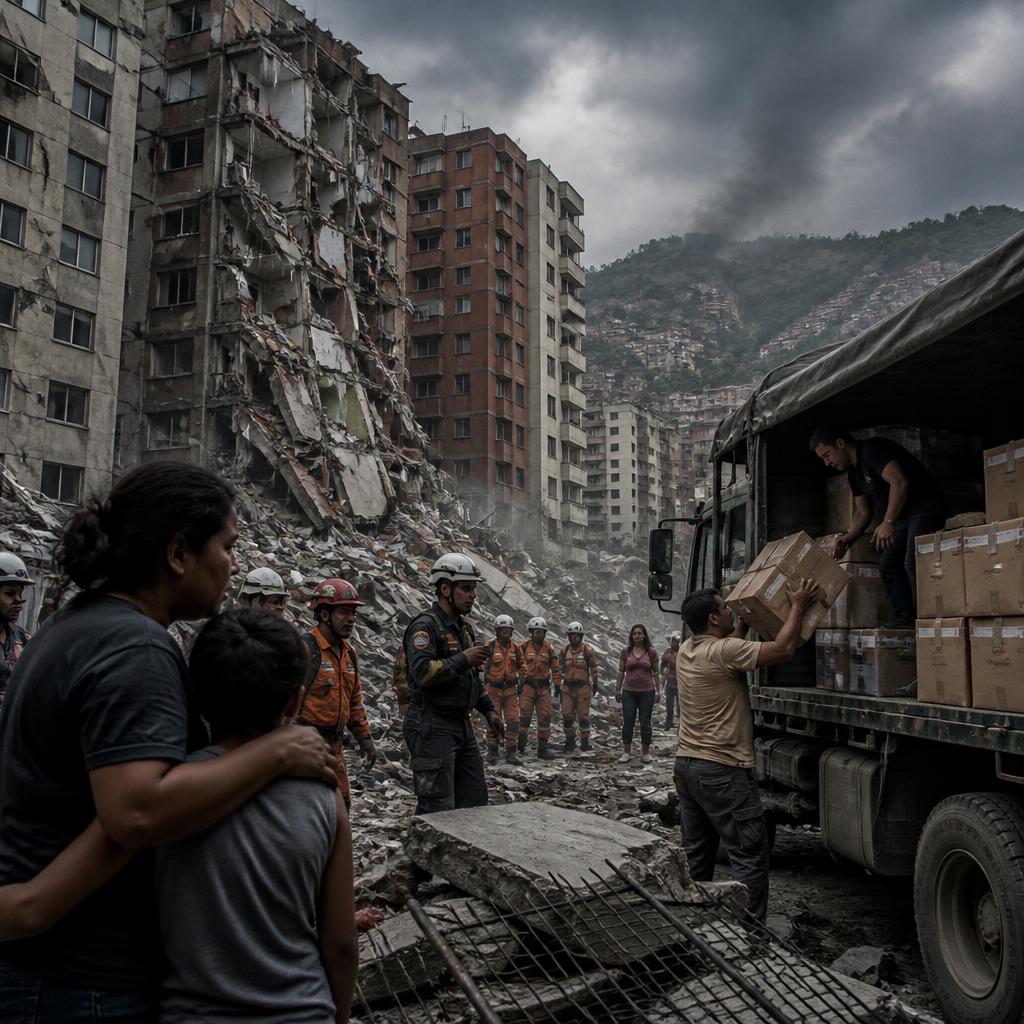
The first hours after an earthquake belong to dust, not diplomacy. Reports from Venezuela describe back-to-back powerful quakes near Caracas, a state of emergency, collapsed buildings, dozens dead, hundreds injured, and a toll still unsettled enough to feel less like a number than a door left open. In that interval, before the official count hardens, people listen for voices under concrete and for the names of relatives who have not answered.
Then the state arrives, as it must, with declarations and uniforms and the uneasy grammar of control. Vice President Delcy Rodriguez declared an emergency, Reuters reported, while early official accounting remained incomplete. That absence matters. Not because every government can know everything immediately after the ground breaks, but because silence has a history in countries where public trust has been worn thin by crisis, migration, sanctions, shortages, and accusation. Disaster does not erase suspicion. It simply makes suspicion work beside rescue crews.
A narrow opening
The United States says it is mobilizing assistance. In ordinary language, that sounds humane and simple. In the long quarrel between Washington and Caracas, it is neither. Aid has to cross sanctions architecture, political pride, logistical damage, and the fear that every pallet will be read as a concession or a trap. A shipment of medical supplies may carry no ideology, but the permission for it to move certainly does.
This is the old sorrow of humanitarian corridors: they are called corridors because the walls remain. The hostile relationship does not disappear; it narrows just enough for water, generators, surgical kits, search equipment, and international agencies to pass through. Each side can still preserve its narrative. Washington can say suffering outranks estrangement. Caracas can accept help without accepting judgment. Meanwhile, families waiting outside ruined apartment blocks do not experience this as diplomatic choreography. They experience time.
There is a temptation, after a catastrophe, to praise the brief softening of enemies as proof of some deeper human order. Sometimes that is deserved. More often it is too clean. Aid can save lives and still be late. A government can declare an emergency and still fail neighborhoods already weakened before the quake. Foreign assistance can be generous and still shaped by leverage. None of that cancels the duty to help. It only keeps the living from being turned into props in a morality play.
What the quakes have rearranged is not the relationship between Venezuela and the United States, but the order of urgency inside it. For a few days, perhaps longer, the argument must make room for rubble. The dead will be counted, the injured moved, the missing named, and the aid routes negotiated through cracks both physical and political. History will return soon enough with its documents and grievances. The question is how many people can be reached before it does.
How did this story land?
This may be changed as you like.