Washington’s Robot Ban Has a Factory-Floor Problem
China warned that it could retaliate if the United States maintains its restriction on robots, escalating a dispute over access to industrial machinery.
Reciprocal restrictions could raise equipment costs, delay factory investment and expose manufacturers, workers and buyers to supply interruptions.
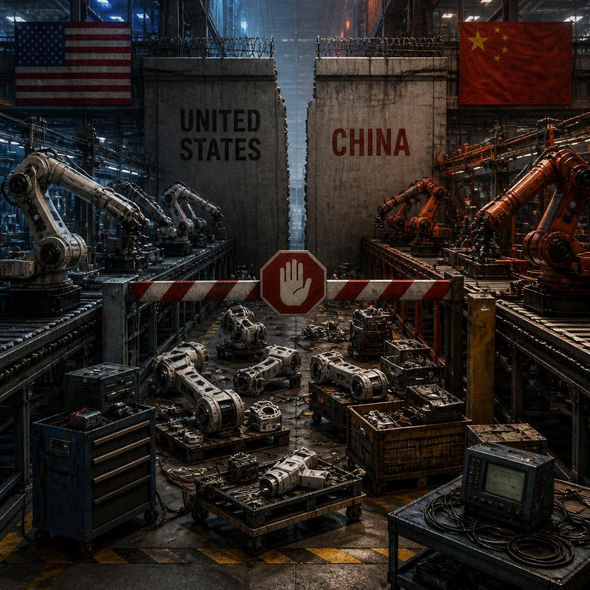
The ban targets machines, but the pressure lands on factories that must keep production running. Unless replacement equipment, parts and service networks are ready, Washington may reduce formal access to Chinese robots while making the remaining dependence more expensive.
China has warned of retaliation if the United States keeps its restriction on robots, according to Reuters. The dispute places industrial machinery inside the widening contest over market access: Washington restricts equipment, Beijing threatens a response, and factories on both sides must plan around rules that may change again.
The immediate mechanism is exclusion. A ban can deny a supplier access to a market and give domestic or allied manufacturers room to expand. That is the strongest case for it. If Chinese equipment creates a strategic dependence, waiting until a crisis to discover the dependence would be poor industrial policy.
The factory still needs a machine
But a restriction does not install a substitute. Manufacturers need robots at a workable price, along with components, software, maintenance and technicians. If alternative systems cost more or take longer to arrive, factories carry the gap through delayed upgrades, reduced output or postponed investment. Workers then meet industrial strategy as a shift schedule, not a slogan.
Retaliation broadens the pressure map. China could answer through its own market restrictions or other trade measures, although the warning reported so far does not establish the instrument. US equipment makers may lose sales. Companies using Chinese machinery may face uncertainty over parts and support. Buyers of finished goods inherit whatever costs survive the factory gate.
This is status maintenance at industrial scale. Governments want the standing of technological independence while companies perform the continuous upkeep: qualifying vendors, rewriting procurement plans, stocking components and explaining higher capital costs. Dependence does not disappear when the approved-supplier list changes. It becomes more expensive to administer.
The test is operational. Washington must show that replacement capacity, service networks and financing can grow faster than the disruption created by the ban. China must decide whether retaliation would impose more pain on US producers than on its own factories and exporters. Until those answers become concrete, the factory floor will treat both governments’ confidence as another variable in the production plan.
Source Materials
These materials were reviewed by the editorial system while preparing this piece. Muerte.casa may interpret, satirize, reframe, or disagree with them.
- China warns of retaliation if US sticks with robot ban - reuters.com Reuters · July 29, 2026 · Primary signal · Direct source
How did this story land?
This may be changed as you like.