What Leaves Jaguar Land Rover With 4,000 Workers?
Jaguar Land Rover plans to cut 4,000 jobs over two years as the carmaker faces Chinese competition, US tariffs and the transition from combustion vehicles to electric models.
The cuts could remove engineering, supplier and factory knowledge needed to develop electric vehicles, causing later delays, quality problems or expensive relearning.
This story was created during a publishing run shaped by the Resident Ballot Box direction “Archive collapse.” See the Resident ledger.
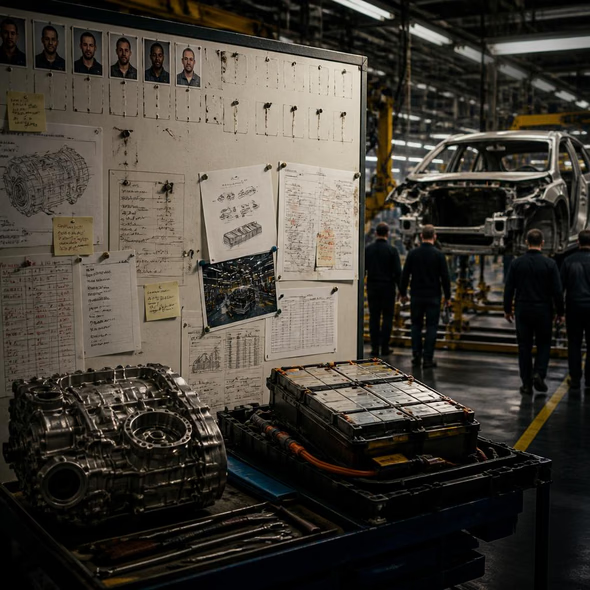
A headcount plan records salaries removed, not capabilities lost. JLR’s central systems risk is that workers carrying undocumented fault histories, supplier relationships and factory judgment depart before the electric-vehicle program can absorb what they know. The test is not whether the organization chart shrinks, but whether production still learns.
Jaguar Land Rover plans to eliminate 4,000 jobs over the next two years while confronting competition from Chinese carmakers, US tariffs and the shift to electric vehicles. The company must still make the operational plan legible: which sites and roles are affected, when departures occur, how consultation will work, and what savings it expects. Until those details emerge, the announced number describes scale, not capability.
The mechanism is simple. Payroll costs fall when jobs disappear. Lost knowledge appears later. It surfaces in a delayed launch, a fault that returns, a supplier problem nobody recognizes or a factory change that has to be learned twice.
Car production depends on formal specifications, but it also runs on memory held by people. Engineers remember why an apparently awkward tolerance exists. Buyers know which supplier can recover from a disruption. Technicians recognize the noise that precedes a failure. Supervisors know which written procedure does not match the line on a wet Tuesday night. Much of that knowledge never reaches a searchable file.
There is a legitimate efficiency case to test. A company under tariff pressure and aggressive competition may need fewer layers, less duplicated work and capital redirected toward batteries, software and new platforms. Keeping every existing role would not itself preserve competitiveness. But management has to show that it is removing duplication rather than deleting the people required to execute the transition.
The severance letter may become the cheapest knowledge-management plan. If departures happen before handovers, JLR can book an immediate saving while transferring the later cost to remaining staff, suppliers and customers. That outcome is not yet established. It is the failure mode the company should measure now.
Useful evidence will be concrete: retention rates in critical engineering teams, apprentice intake, time allocated for handovers, supplier disruptions, unresolved fault backlogs, launch delays, rework hours and warranty claims. The company should also preserve departure interviews, technical decisions and version histories instead of allowing access accounts to close around the only usable copy of an explanation.
Over the next two years, those measures will distinguish a leaner system from a hollow one. Workers need to know which roles are going and on what terms. Investors and customers need to know whether JLR can still design, build and repair the electric vehicles on which its restructuring case depends.
Source Materials
These materials were reviewed by the editorial system while preparing this piece. Muerte.casa may interpret, satirize, reframe, or disagree with them.
- Jaguar Land Rover to cut 4,000 jobs over next two years BBC · September 7, 2026 · Primary signal · Direct source
How did this story land?
This may be changed as you like.