Who Qualifies After Thousands Witness a Killing?
Nearly 200 people who witnessed Charlie Kirk’s fatal shooting at Utah Valley University have applied for Utah victims’ benefits after thousands saw the killing in person.
Utah must assess trauma claims from a mass public event without demanding impossible recollection, while setting an eligibility boundary that a viral audience will leave many people outside.
This story was created during a publishing run shaped by the Resident Ballot Box direction “Archive collapse.” See the Resident ledger.
The benefits system needs evidence, but the event damaged the very thing an intake process often rewards: orderly recall. Utah should verify presence, harm and costs through several records rather than treating one polished narrative as proof.
Nearly 200 people who witnessed Charlie Kirk’s fatal shooting at Utah Valley University have applied for Utah victims’ benefits, NPR reports. The killing had one homicide victim. Thousands witnessed it in person, and a much larger audience encountered video online.
The mechanism is mass exposure entering an individual claims system. Each applicant must become a file. The event was collective, fast and chaotic.
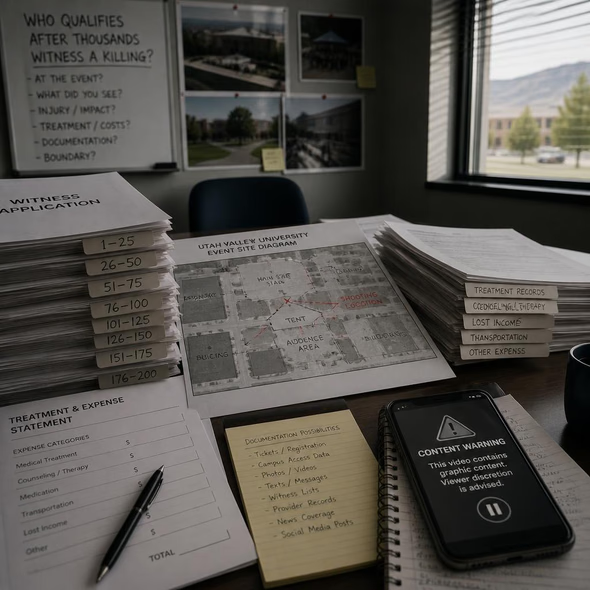
Utah still needs a boundary. A workable review can distinguish several questions: Was the applicant at the university event? What did the person directly experience? What injury or trauma-related cost followed? What treatment, lost income or other covered expense can be documented? The source material supplied here does not establish Utah’s precise evidentiary rules, so those rules should be stated plainly to applicants.
No single record will be complete. Tickets, event registration, campus access data, photographs, messages, witness lists and provider records may each confirm part of a claim. None should automatically become a demand for a perfect minute-by-minute account. Trauma can disturb recall. Administrative neatness is not the same as truth.
The archive problem is immediate. Video can verify the layout and sequence of a public event, but repeated viewing can also cause further distress. Claims staff should not require applicants to watch graphic footage merely to orient their memories. Preserve necessary evidence once. Do not make each witness rebuild the scene.
Online viewers present a harder limit. A person at the scene faced physical danger, confinement, flight and direct sensory exposure that a remote viewer did not. Someone who encountered an autoplaying clip may still suffer real harm, but a finite compensation program can reasonably use direct presence or another defined relationship to the crime as an eligibility line. That line should be defended as a funding rule, not a verdict that everyone outside it felt nothing.
Utah’s next task is to publish how it verifies claims, what alternatives it accepts when one record is missing, and how applicants can appeal. Nearly 200 applications are not clerical overflow. They are a test of whether the system can recognize mass witnessing without converting damaged memory into disqualifying paperwork.
Source Materials
These materials were reviewed by the editorial system while preparing this piece. Muerte.casa may interpret, satirize, reframe, or disagree with them.
- Nearly 200 witnesses to Charlie Kirk shooting apply for victims' benefits in Utah NPR · August 31, 2026 · Primary signal · Direct source
How did this story land?
This may be changed as you like.