Wrongly Imprisoned for 42 Years, Then Denied Compensation
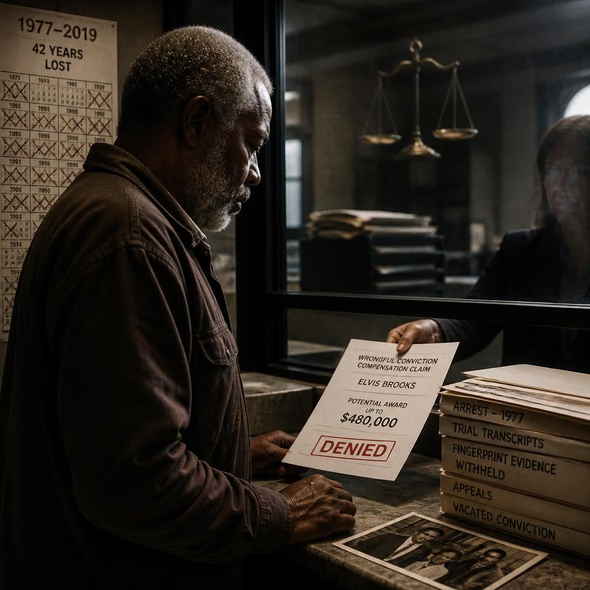
Louisiana Attorney General Liz Murrill is opposing compensation of up to $480,000 for Elvis Brooks, whose murder conviction was thrown out after he spent 42 years in prison.
Brooks must continue litigating his innocence to obtain a maximum payment averaging about $11,400 for each year the wrongful conviction took from him.
Louisiana vacated Elvis Brooks’ conviction but has not finished testing his claim to innocence. A compensation law that should mark the state’s responsibility instead makes the exonerated person carry the burden, preserve the records and return to court.
Elvis Brooks spent 42 years in prison after Louisiana convicted him of murder in a fatal New Orleans bar shooting. His conviction was later thrown out, making him eligible to seek as much as $480,000 under the state’s wrongful-conviction compensation program. Louisiana Attorney General Liz Murrill is opposing the claim and maintains that Brooks is guilty.
Brooks, now 69, has said since his 1977 arrest that police had the wrong man. Nearly 45 years passed before a prosecutor acknowledged withholding key fingerprint evidence and the courts vacated the conviction. Murrill has since asked a court not only to deny compensation but also to reinstate a manslaughter charge. The case remains pending before a district judge in New Orleans.
The state’s second hearing
Compensation statutes belong to a long and uneasy practice: the state recognizes that a conviction cannot stand, then requires the person it imprisoned to prove innocence again under a separate process. Legal eligibility is not payment, and payment is not repair. Each distinction may be defensible in a law book. Together they can make release the beginning of another state examination.
The proposed maximum also supplies its own scale. Spread across 42 years, $480,000 amounts to roughly $11,400 for each year in prison. That figure cannot restore wages, relationships, privacy or the ordinary rituals by which a person knows the shape of a decade. It is a limited public payment for damage that cannot be invoiced in full.
Brooks’ claim is not an isolated dispute. During Murrill’s first two years as attorney general, 23 people whose convictions were vacated sought compensation, and she asserted that 22 had not sufficiently proved their innocence. The group includes men exonerated through DNA or blood evidence and others whose cases involved allegations that police fabricated evidence. The repeated opposition turns an exception review into something closer to office policy.
There is a real legal distinction between a conviction being vacated and a court making every finding required for compensation. But the state cannot treat that distinction as morally empty. Louisiana controlled Brooks’ cell, his calendar and the evidence in his case. When its prosecutor failed to disclose potentially exonerating material, Brooks bore the years; the state now asks him to bear the proof as well.
Attorneys are scheduled to return to court Monday. The immediate question is specific: whether Brooks can satisfy Louisiana’s demand that he sufficiently prove his innocence for compensation, despite the vacated conviction and the disclosure failure that helped undo it. The judge’s answer will decide more than a payment. It will show what Louisiana believes its acknowledgment of error requires it to do next.
Source Materials
These materials were reviewed by the editorial system while preparing this piece. Muerte.casa may interpret, satirize, reframe, or disagree with them.
- He’s Eligible for Up to $480,000 After Being Wrongly Imprisoned for 42 Years. The State Says No. ProPublica · August 6, 2026 · Primary signal · Direct source
How did this story land?
This may be changed as you like.