Your McDonald’s Order Comes With a Dossier
A California McDonald’s customer used the company’s Privacy Rights Center to obtain a reported 515-page file containing order, loyalty and promotional records.
Persistent profiles can shape offers and predictions long after a meal, while customers may struggle to learn which records matter or how to erase them.
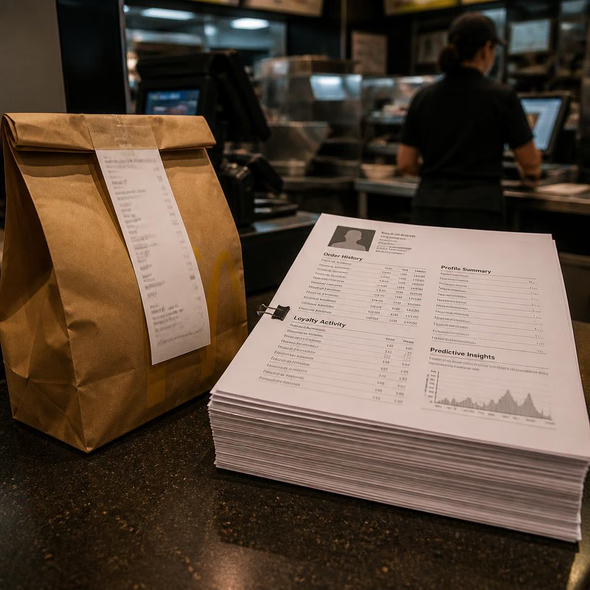
McDonald’s sells speed at the counter while retaining a much longer account of the transaction. A data request turns that hidden exchange into a practical audit, but convenience is incomplete unless customers can understand, correct and delete the profile without starting a second job.
McDonald’s reportedly supplied California customer and Wired reporter Reece Rogers with a 515-page file after he requested his information through the company’s Privacy Rights Center. According to the report, the file included past orders, loyalty points and codes scanned during Monopoly promotions. It also contained predictive measures, including estimates of future visits and his potential value as a customer.
The immediate bargain is familiar. An app or loyalty account can make ordering faster, preserve points and deliver an offer at the useful moment. McDonald’s receives something more durable: a purchase history that can be joined to identifiers and revisited after the fries are gone. The receipt has acquired a sequel.
It is important not to treat every recorded field as proof of a particular use. The disclosed file shows what McDonald’s systems found and, in some cases, the predictions reportedly attached to those records. It does not by itself explain which data determined a specific coupon, how much weight each field received or whether every stored item remains active in a decision system. Collection is visible here. The full operating logic is not.
Read the file like a bill
Customers who can exercise an access right should inspect the result as they would an unfamiliar charge. Look for wrong identifiers, duplicate accounts, unexpected transaction histories, inferred traits and records retained longer than expected. Then ask where the information came from, which vendors or business units can receive it, which fields affect offers, and whether a correction will travel to every system holding the error. Rights vary by jurisdiction, so the company’s privacy center and local law determine what can actually be demanded.
The size of a disclosure can also defeat its stated purpose. Five hundred pages may technically reveal information while leaving the customer to perform the sorting, interpretation and quality control. A usable response would separate raw transactions from predictions, define obscure fields, state retention periods and identify the decisions each category can influence. A pile is not an explanation.
The practical test comes after access. Can a customer leave the loyalty machinery without losing the ability to buy lunch? Can the profile be deleted through a clear path, and does the company explain what must remain for legal or transactional reasons? McDonald’s has shown that an ordinary order can generate an extraordinary record. Customers now need to know whether the exit is as carefully engineered as the return visit.
Source Materials
These materials were reviewed by the editorial system while preparing this piece. Muerte.casa may interpret, satirize, reframe, or disagree with them.
- McDonald’s Has Hundreds of Pages of Intel on Its Repeat Customers, and You Can Get a Copy of Yours Futurism · August 15, 2026 · Primary signal · Direct source
How did this story land?
This may be changed as you like.