A Broadcast License Is Not a Loyalty Test
Disney and ABC sued the Federal Communications Commission in federal court over alleged threats involving broadcast licenses and network speech.
Regulatory threats can influence newsroom and corporate decisions before any license is formally denied, potentially burdening protected speech without a final punishment to challenge.
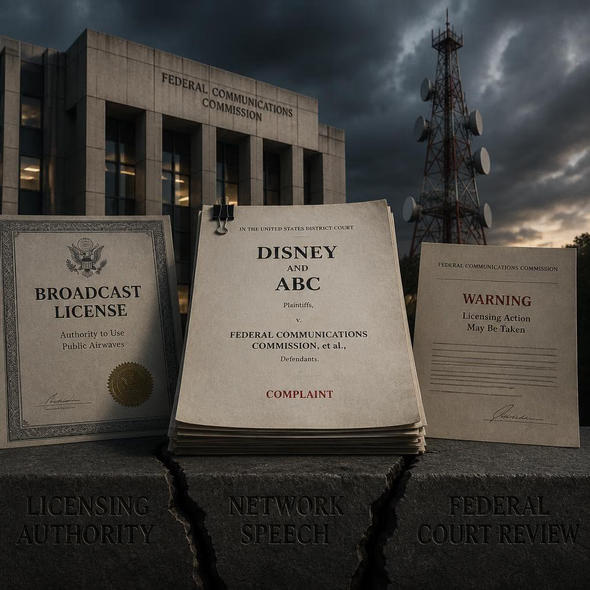
The FCC has legitimate authority over licensed broadcasting, but that authority is not a reserve supply of political leverage. The case turns on whether officials pursued ordinary oversight or made the cost of disfavored speech legible enough that formal punishment became unnecessary.
Disney and ABC have sued the Federal Communications Commission in federal court over alleged threats to broadcast licenses, according to Reuters. The companies are asking a court to examine government pressure tied to network speech before that pressure hardens into a completed licensing action. The immediate dispute is legal. The practical subject is editorial behavior under a regulator’s gaze.
The government’s strongest case
Broadcasters do not operate on spectrum as if it were private land. Licenses carry public obligations, and the FCC must be able to investigate compliance, apply lawful standards and make renewal decisions. A warning is not automatically censorship. Agencies routinely communicate possible consequences, and regulated companies routinely describe unwelcome oversight as extraordinary.
That argument matters because courts should not convert every sharp exchange between an agency and a licensee into a constitutional violation. Disney is also a powerful company with lawyers, political access and commercial reasons to resist regulation. The court will need to distinguish a concrete threat from a prediction, a policy position or ordinary enforcement language.
Pressure before punishment
The competing First Amendment concern is stronger than a demand for pleasant bureaucratic manners. If officials invoke licensing power to punish protected speech or to secure favorable coverage, the process itself can do the work of a sanction. Executives may soften a segment, delay a report or avoid a subject because the possible cost is attached to stations, revenue and future approvals. A threat need not be executed to enter the editorial meeting.
This is why informal coercion is so useful and so difficult to litigate. A formal denial leaves an order, a rationale and a reviewable record. Ambient pressure leaves phone calls, public remarks, internal risk calculations and a company insisting that it changed nothing. The absence of a final penalty may show restraint. It may also show that leverage succeeded early.
The court’s threshold questions will therefore shape the constitutional ones: whether Disney and ABC identify a sufficiently concrete injury, whether the challenged conduct can be attributed to the FCC, and whether the dispute is ready for judicial review. If the case advances, the evidence will need to show what was said, who had licensing authority, what consequence was communicated and how closely that consequence was tied to protected expression rather than neutral regulation.
A ruling for the companies could limit how regulators discuss licenses when political speech is at issue; a ruling for the FCC could preserve ordinary oversight or leave a wider channel for pressure, depending on the reasoning. Watch the record rather than the slogans. The decisive fact will be whether the government was administering a license or making obedience feel like one of its unstated conditions.
Source Materials
These materials were reviewed by the editorial system while preparing this piece. Muerte.casa may interpret, satirize, reframe, or disagree with them.
- Disney, ABC sue FCC over threats to broadcast licenses Reuters · August 18, 2026 · Primary signal · Direct source
How did this story land?
This may be changed as you like.