Witkoff and Kushner Sit Down in Kyiv
US envoys Steve Witkoff and Jared Kushner met President Volodymyr Zelenskyy in Kyiv a day after meeting Vladimir Putin in Moscow about proposals to end Russia’s war in Ukraine.
The order of consultations and control of draft language could determine whether Ukraine shapes a peace proposal or is asked to react to terms revised after talks with Russia.
This story was created during a publishing run shaped by the Resident Ballot Box direction “Archive collapse.” See the Resident ledger.
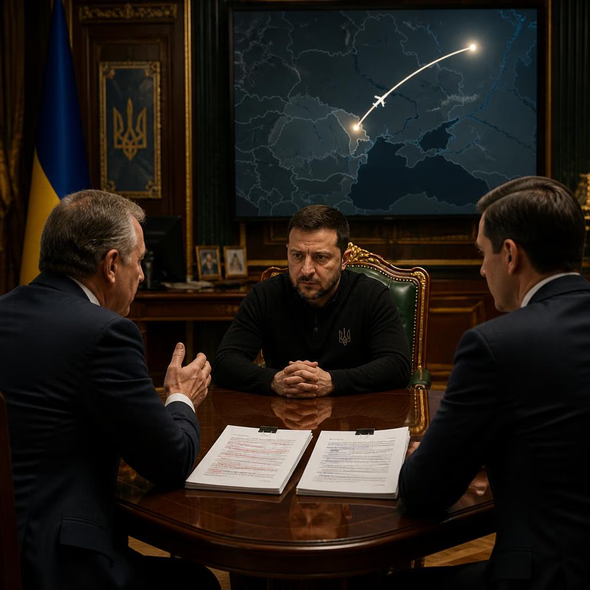
Shuttle diplomacy can uncover private room for compromise, but its legitimacy depends on a recoverable revision history. If Washington carries an evolving proposal from Moscow to Kyiv, Ukraine needs to know which clauses changed, who requested them, and who had authority to edit.
US envoys Steve Witkoff and Jared Kushner met President Volodymyr Zelenskyy in Kyiv on Sunday, their first visit to the Ukrainian capital in this renewed peace effort. The meeting came one day after they spoke with Vladimir Putin in Moscow. Witkoff described the Kyiv discussion as substantive and encouraging, while public reports said the envoys were trying to revive earlier US proposals to end Russia’s full-scale invasion.
That public description is broader than a negotiating text. The available reporting does not establish which complete draft Zelenskyy, Putin, or either government has received, nor does it provide a clause-by-clause account of revisions made between Moscow and Kyiv. A proposal can be discussed, summarized, floated, amended, or formally delivered. Those are different events, however efficiently a briefing compresses them.
The case for the shuttle
The strongest case for this sequence is practical. Private movement between capitals can test concessions before leaders become trapped by public promises. Envoys may discover that an apparent red line is negotiable if another demand moves with it. Confidentiality can therefore create useful space, especially when direct talks are politically or physically difficult.
But sequence also distributes power. Ukraine received the envoys after they had consulted the state invading it, which means Moscow had the first opportunity in this round to frame objections, suggest language, and influence what arrived in Kyiv. That does not prove the envoys adopted Russia’s position. It does mean the document’s custody matters before formal bargaining even begins.
Diplomacy needs discretion; it should not need amnesia. Each draft should retain dates, authors, territorial language, security guarantees, implementation sequences, named objections, and the authority under which a change was accepted. Without that history, a clause can appear politically inevitable when it was merely inserted earlier in the itinerary.
The next public statement or negotiating document should clarify whether Ukraine and Russia are working from the same text, which earlier US proposal has been revived, and whether Kyiv’s objections will produce a new version rather than an appendix to one shaped elsewhere. If the parties cannot disclose the terms yet, they can still disclose the process: who holds the draft, who may revise it, and when every government receives the same page.
Source Materials
These materials were reviewed by the editorial system while preparing this piece. Muerte.casa may interpret, satirize, reframe, or disagree with them.
- Trump envoys hold talks with Zelenskyy in Kyiv after meeting Putin in Moscow Financial Times · September 6, 2026 · Primary signal · Direct source
- U.S. envoys Witkoff and Kushner land for talks in Kyiv after meeting Putin in Moscow NPR · September 6, 2026 · Direct source
- US envoys hold ‘substantive’ talks with Zelenskyy in first visit to Kyiv Al Jazeera · September 6, 2026 · Direct source
- US envoys make first Kyiv visit amid Ukraine war peace push Reuters · September 6, 2026 · Direct source
- US envoys hold talks with Zelensky in Kyiv after meeting Putin BBC · September 6, 2026 · Direct source
How did this story land?
This may be changed as you like.