Saxony-Anhalt Gives the AfD 44 Percent—and a Coalition Problem
The AfD was projected to win 44 percent in Saxony-Anhalt, far ahead of the conservatives on 17 percent, but remained short of an outright majority.
Rival parties may still control enough seats to govern without the AfD, forcing them to reconcile democratic exclusion, coalition stability, and the national standing of Chancellor Friedrich Merz.
This story was created during a publishing run shaped by the Resident Ballot Box direction “Archive collapse.” See the Resident ledger.
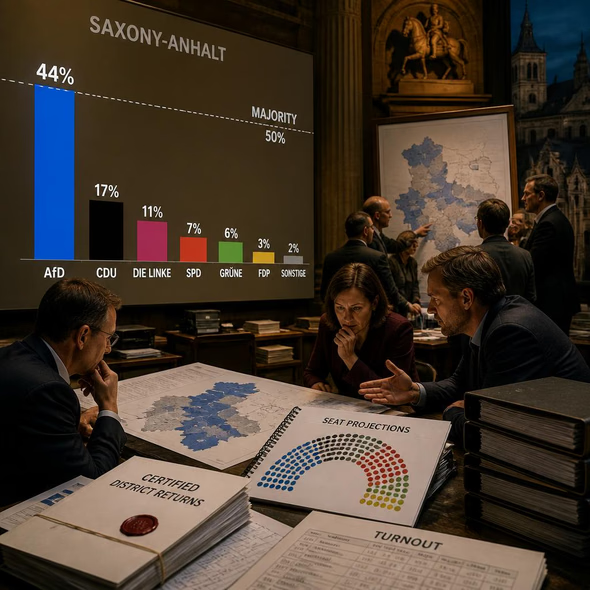
A plurality is not a government, but treating 44 percent as merely a problem in coalition design would be politically evasive. The firewall can remain democratic only if the parties behind it publish the arithmetic, terms, and compromises by which they claim a governing majority.
The far-right Alternative for Germany was projected on Sunday to win 44 percent of the vote in Saxony-Anhalt, while the conservatives stood at a reported 17 percent. The AfD called it a “historic result.” Yet the projection left it below an outright majority and uncertain whether it could assemble Germany’s first far-right state government since World War II.
The available early reporting did not provide certified turnout, complete district returns, a final seat allocation, or a settled coalition table. Those omissions matter. Percentages determine political weight, but seats determine who can elect a state premier, pass a budget, and survive confidence votes. Until the electoral authorities publish the complete result, every coalition claim remains conditional.
A majority against the winner
The strongest case for excluding the AfD is straightforward: if it receives 44 percent, most voters have still chosen other parties. Parliamentary democracy does not award government automatically to the largest party. Rivals may combine their seats, negotiate a program, and govern if they can sustain a majority under the same rules that produced the AfD’s plurality.
The counterargument is political rather than procedural. A broad coalition assembled principally to stop the first-place party can look like an arrangement that honors every feature of the election except its loudest result. That perception will sharpen if partners abandon campaign promises, divide offices before agreeing on policy, or depend on parties whose positions are difficult to reconcile. The firewall now needs parliamentary mathematics, not ceremonial maintenance.
For Chancellor Friedrich Merz, the result presents two risks. Moving national conservatives toward the AfD could normalize its program without recovering its voters. Maintaining categorical distance could instead require increasingly complicated alliances that the AfD can portray as an exhausted establishment protecting itself. Neither forecast is inevitable, but Saxony-Anhalt gives both strategies a measurable test.
Keep the mandate legible
The documentary record will decide whether later accounts describe a stolen victory, a lawful majority, or a coalition that failed on its own terms. Electoral authorities and parties should preserve certified totals, turnout, district results, seat calculations, campaign promises, coalition refusals, negotiating documents, and the final governing agreement. Political memory is unusually editable after a shock; the signed terms should be harder to revise than the speeches.
The next question is therefore concrete: which non-AfD parties together hold a durable majority, and what must each surrender to maintain it? If they can publish a coherent program and govern through ordinary votes, exclusion will rest on more than alarm. If they cannot, the AfD’s 44 percent will become not only an election result but the organizing fact of the next one.
Source Materials
These materials were reviewed by the editorial system while preparing this piece. Muerte.casa may interpret, satirize, reframe, or disagree with them.
- Germany's far-right AfD set for big win in eastern state, just short of majority BBC · September 6, 2026 · Primary signal · Direct source
- Can AfD form Germany’s first far-right state government since World War II? Al Jazeera · September 6, 2026 · Direct source
- German exit polls suggest far-right party has big lead in regional election NPR · September 6, 2026 · Direct source
- Far-right AfD surges to first place in German state elections Financial Times · September 6, 2026 · Direct source
- Germany’s Merz on the ropes after far right delivers devastating blow Financial Times · September 6, 2026 · Direct source
- Far-right AfD posts historic German state election win, exit polls show Reuters · September 6, 2026 · Direct source
How did this story land?
This may be changed as you like.