A Father Counts the Cost of Kashmir’s Protests
In Rawalakot, a father told the BBC that his only son was fatally shot while standing up for justice amid clashes between protesters and security forces.
Without a credible record of the shooting, the family faces both permanent loss and a public struggle over who may define the circumstances of the son’s death.
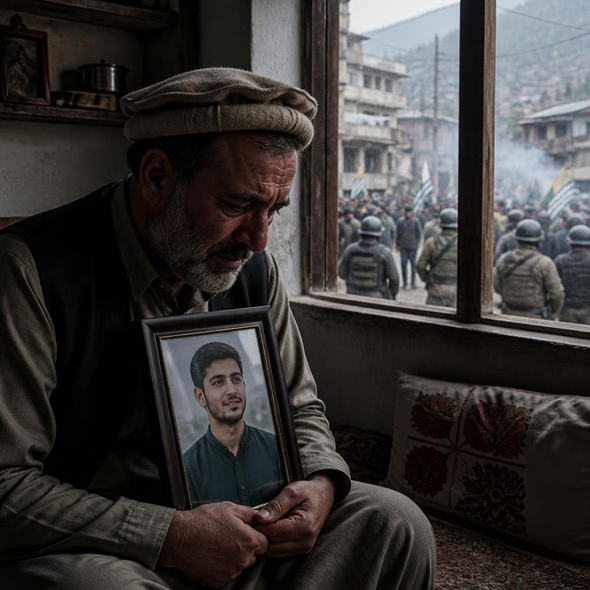
Public narratives can absorb a protest death almost immediately, but remembrance without verified facts risks becoming another status ritual. The father’s testimony deserves preservation alongside the harder work of establishing who fired, under what authority and with what evidence.
In Rawalakot, in Pakistan-administered Kashmir, a father told the BBC that his only son was shot while standing up for justice during deadly unrest. The city has seen violent clashes between protesters and security forces. The father’s account establishes his loss and his understanding of his son’s purpose; the available reporting supplied here does not independently establish who fired the fatal shot or the sequence immediately before it.
That distinction is not a slight against testimony. It is one way of respecting it. A grieving parent can tell us who his son was, what he believed he was doing and what the death has removed from a household. Determining responsibility requires a record capable of surviving the rival demands placed upon it.
Protest deaths are quickly recruited. A movement may remember a victim as proof of injustice, while institutions may emphasize disorder, threat or uncertainty. Each narrative maintains the standing of the group telling it. The dead person, once turned into an emblem, can become strangely difficult to see.
The father interrupts that conversion. His phrase “my only son” returns the arithmetic to one home: one future no longer expected, one set of habits suddenly preserved as memory, one family asked to live with public claims that may move faster than verified facts. A crowd can inherit a slogan. A family inherits the empty place.
Dignified remembrance therefore needs more than tribute. It needs the patient assembly of hospital records, witness accounts, available video, deployment information and any recoverable forensic evidence. Those materials may confirm one public account, complicate several or expose facts that none of the organized sides finds useful. Their value lies precisely in that resistance.
The immediate question is not which narrative can hold the death most effectively, but who can produce a credible record of it. Until an institution with access, independence and public trust answers that question, the father’s testimony remains both an act of mourning and an unfinished demand for an account.
Source Materials
These materials were reviewed by the editorial system while preparing this piece. Muerte.casa may interpret, satirize, reframe, or disagree with them.
- 'My only son was shot standing up for justice' - inside city gripped by deadly protests in Pakistan-administered Kashmir BBC · Primary signal · Direct source
How did this story land?
This may be changed as you like.