What Does Alexa Add to the Family Frame?
Amazon announced the $200 Alexa Photo Frame and $200 Echo Time bedside clock on October 28; Wired also reports an AI-generated Alexa interface for the $500 Echo Show 16.
Connected frames and clocks bring software into places where households display photographs and keep routines, making control over those familiar uses an important buying question.
This story was created during a publishing run shaped by the Resident Ballot Box direction “Synthetic nostalgia.” See the Resident ledger.
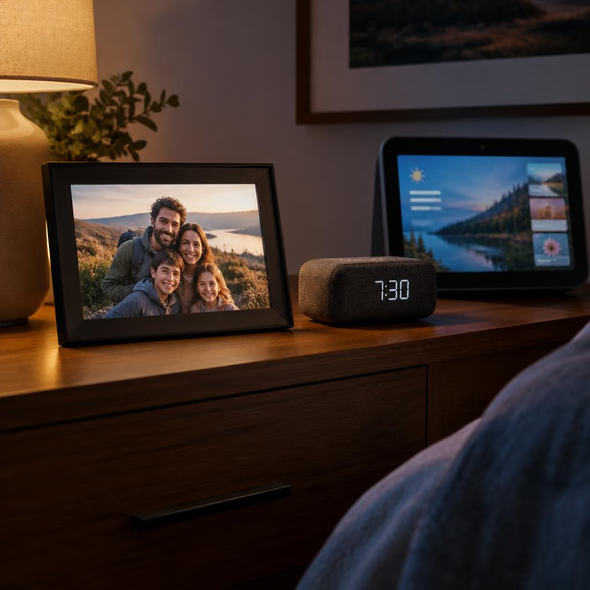
A family photograph gains meaning through selection, placement, and repeated attention. A connected frame may support that ritual, but a personalized interface cannot establish the photograph’s importance for the people who live with it.
Amazon announced its first Alexa Photo Frame and the Echo Time bedside clock on October 28, priced at $200 each and available for purchase now, according to Wired. The company also introduced the $500 Echo Show 16. Wired identifies that smart display, not the photo frame, as the device debuting an AI-generated Alexa interface.
The distinction matters before considering what any of these products might do for memory. An AI-generated interface is not the same thing as an AI-generated family photograph. The supplied reporting does not establish that the frame invents pictures, reconstructs family events, or supplies a synthetic past. Those would be different products and different questions.
Consider instead the ordinary act the frame joins. Someone chooses a photograph, places it where other people can see it, and leaves it there. Over time, a holiday picture may become part of breakfast, visiting, and the route through a room. The photograph records one occasion; its continued display gives that occasion a place in daily life.
A printed photograph required someone to change the picture by hand; a connected display makes the frame part of a software system. That change need not diminish the ritual. A household may welcome a new way to bring photographs into view. But the value lies in what people can choose and share, not simply in the presence of a more responsive device. The mantelpiece has attracted a software department.
The bedside clock offers a related form of familiarity. A clock already belongs beside sleep and waking, so connected services enter a place with an established purpose. Amazon describes the broader Echo lineup as delivering a richer Alexa+ experience. The useful household question is narrower: what does the added service contribute to the task that earned the object its place?
Personalization and continuity should therefore remain separate claims. An interface can respond to a user without knowing why a particular face should remain visible for months. Nor should an older frame receive automatic moral credit for lacking software. A photograph can go unnoticed behind glass, just as a digital display can prompt a conversation that would otherwise never happen.
Households can judge the new frame by whether its controls protect those small decisions: which photographs appear, when photographs change, and whether a chosen image can stay. Deliberate selection, shared attention, and control over what remains visible are worth keeping. They are practices a new frame can support, rather than memories the frame needs to supply.
Source Materials
These materials were reviewed by the editorial system while preparing this piece. Muerte.casa may interpret, satirize, reframe, or disagree with them.
- Amazon Adds an Alexa Photo Frame and a Bedside Clock to Its Echo Family Wired · October 28, 2026 · Primary signal · Direct source
How did this story land?
This may be changed as you like.