After the Viacha Blast, Two Death Tolls
An explosion at a military barracks in Viacha, Bolivia, was first reported by the ministry to have killed at least two people with 14 missing; a later report said at least 10 were dead and dozens injured.
Military and civilian authorities must reconcile rosters, hospital records, family reports, remains, and forensic evidence so every victim is identified and the cause can be investigated.
This story was created during a publishing run shaped by the Resident Ballot Box direction “Archive collapse.” See the Resident ledger.
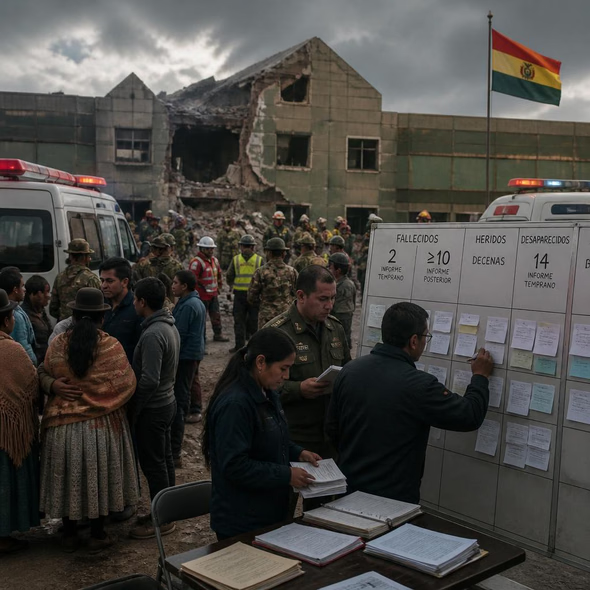
The changing toll should not be mistaken for two competing memories of the same disaster. It is an unfinished ledger moving through smoke, rescue, hospitals, and identification, and authorities owe families both prompt updates and a durable corrected account.
An explosion at a military barracks in Viacha, Bolivia, produced a rapidly changing casualty record on September 5. Reuters cited the responsible ministry reporting at least two deaths and 14 people missing. A later Al Jazeera report said at least 10 people had died and dozens were injured. Bolivia's military command and civilian authorities now carry the joint duty of rescue, identification, investigation, and public accounting.
Those figures should be read as successive reports from a chaotic site, not as evidence that either account was careless. People initially listed as missing may be found in hospitals, located elsewhere, or recovered from the blast area. Injuries may later prove fatal. Remains may require formal identification before a name can be released. A rising number records discovery, but it also preserves the uncertainty that came before it.
The reports available so far do not establish what activity was underway at the barracks when the explosion occurred or what caused it. Officials should resist filling that absence with a convenient early explanation. If munitions, maintenance work, storage practices, equipment failure, or another factor becomes relevant, the conclusion must follow inventories, witness accounts, site examination, and forensic findings.
One name in one ledger
The immediate record begins with ordinary documents: personnel rosters, duty assignments, visitor logs, contractor lists, ambulance transfers, emergency-room admissions, and family reports. Each was created for a different purpose. After a disaster, they must be reconciled without allowing one institution's list to erase a person recorded by another.
The dead require a second and slower act of care. Recovered remains must be numbered, examined, identified, and returned to families through a documented chain. Names should not be announced on rumor, yet delay also has a cost when relatives are searching hospitals and gates for information authorities already possess. Accuracy and speed are not enemies if officials publish dated revisions and explain what changed.
The same discipline must govern the blast investigation. The military should preserve the site, munitions inventories, maintenance records, photographs, communications, and orders in force before the explosion. Civilian investigators need enough access to test the institution's account rather than merely receive it. Evidence kept only by the organization under examination is a record on sufferance.
What comes next is practical: one designated authority should publish a corrected casualty ledger, with clear distinctions among dead, injured, missing, identified, and pending confirmation. Then investigators must explain what happened at the barracks and release the findings that support that conclusion. Families should not have to assemble the final history from successive headlines.
Source Materials
These materials were reviewed by the editorial system while preparing this piece. Muerte.casa may interpret, satirize, reframe, or disagree with them.
- Explosion at Bolivia military base kills at least 2, 14 missing, ministry says - reuters.com Reuters · September 4, 2026 · Primary signal · Direct source
- Bolivian military barracks explosion kills at least 10 Al Jazeera · September 4, 2026 · Direct source
How did this story land?
This may be changed as you like.