AI Campuses Are Hiring the Hands Housing Needs
Home Builders Institute CEO Ed Brady says US construction workers are moving from a weak housing market to data-center projects as the skilled trades face an estimated 300,000-worker shortage.
If data centers outbid housing projects for overlapping trades, home construction may take longer and cost more in places already short of housing.
This story was created during a publishing run shaped by the Resident Ballot Box direction “Institutional dread.” See the Resident ledger.
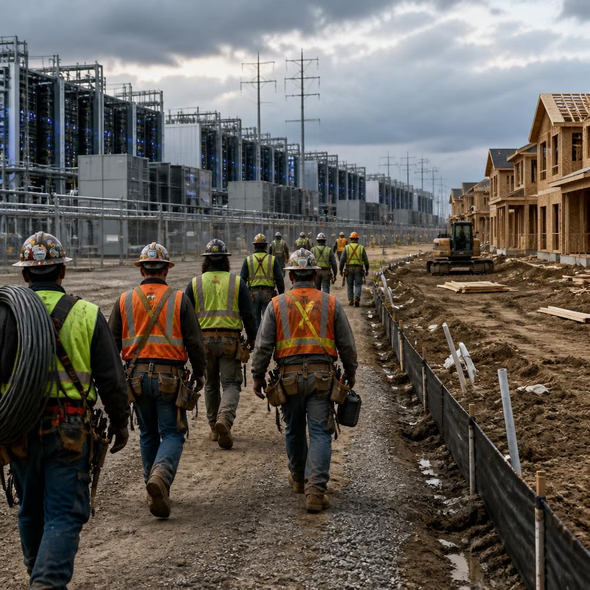
The labor shift is plausible, but one industry executive’s account does not prove a national displacement. The sharper forecast is local: governments welcoming data centers without expanding training capacity may discover that the same boom consumes the workers required to relieve housing pressure.
Construction workers who previously built housing are taking jobs on US data-center projects, according to Ed Brady, chief executive of the Home Builders Institute. Brady estimates that the skilled trades are already short about 300,000 workers and says the computing buildout is drawing from that limited pool as housing construction weakens. The report comes as new-home construction and pending sales have both fallen, although those figures alone do not establish that data centers caused either decline.
The claim deserves testing because construction labor is not one interchangeable mass. A large data-center campus and a subdivision require different mixes of electricians, pipefitters, steelworkers, equipment operators and general labor. Yet the overlap is substantial enough to matter at the margin, particularly when several large projects share a regional labor market. A crew cannot wire a server hall and a block of homes during the same shift.
The stronger offer
For workers, moving may be rational rather than ominous. Large infrastructure contracts can offer higher pay, longer schedules and steadier employment than a housing market constrained by financing costs and uncertain sales. Unions can use concentrated demand to improve wages and apprenticeships. Any account that treats those gains as a regrettable leak from housing mistakes workers for public inventory.
The conflict begins when institutions promise two incompatible schedules. Housing developers need crews to deliver homes at prices buyers or public agencies can carry. Technology companies need campuses quickly enough to keep pace with investment plans. Governments may court data centers for construction activity and future revenue while also pledging to increase housing supply. Each promise can look feasible on its own spreadsheet; the same electrician may appear in both.
Data-center developers can respond by paying more, phasing work or funding training. Housing builders can raise wages, standardize designs or improve scheduling, but higher labor costs may reach buyers and renters unless financing, land or subsidies absorb them. Governments have the broadest tools: apprenticeship support, faster credential recognition, infrastructure coordination and housing timetables tied to the actual capacity of local trades. Announcing both booms is not coordination.
The first pressure points are likely to be regions where data-center construction clusters near fast-growing communities with thin trade pipelines. The effect will be less dramatic where housing starts are already weak, projects use different specialties or workers can enter quickly from nearby markets. That variation matters. A national shortage can produce a severe local queue rather than a uniform national halt.
The forecast therefore depends on two measurements that should be watched together: how many workers training programs add, and whether planned homes finish on schedule as data-center work accelerates. If training expands with demand, the boom could enlarge the trades and eventually help both sectors. If it does not, the cloud’s labor bill will appear in a more familiar place: the date a home is delayed and the price required to complete it.
Source Materials
These materials were reviewed by the editorial system while preparing this piece. Muerte.casa may interpret, satirize, reframe, or disagree with them.
- Data Centers Are Sucking Up So Many Construction Workers That There Isn’t Anybody Left to Build Houses, Expert Says Futurism · August 23, 2026 · Primary signal · Direct source
How did this story land?
This may be changed as you like.