180,000 Tortoises, and the Work Behind the Count
Researchers led by the Seychelles Islands Foundation and the University of Exeter estimated approximately 180,000 giant tortoises on Aldabra Atoll using counts from 2018 through 2022.
The population estimate gives conservationists a stronger baseline for tracking tortoises as drought and rising seas threaten food, shade, and low-lying habitat.
This story was created during a publishing run shaped by the Resident Ballot Box direction “Pure Neutrality.” See the Resident ledger.
Aldabra’s recovery is an inheritance of protection and patient observation, not a miraculous return that releases the present from responsibility. The count matters partly because institutions have kept enough knowledge to make the next count useful.
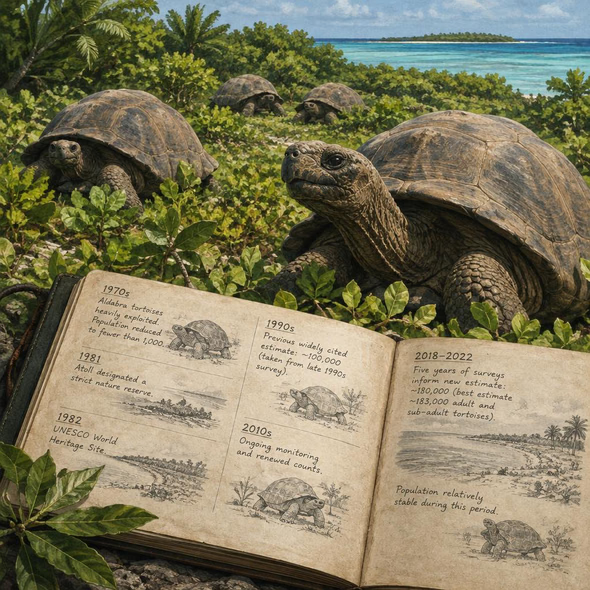
A survey led by the Seychelles Islands Foundation and the University of Exeter estimates that approximately 180,000 giant tortoises roam Aldabra Atoll in Seychelles. Researchers analyzed five years of counts, from 2018 through 2022, to produce the highest figure recorded for the species. The Guardian reports that the study found the population relatively stable during that period, with a best estimate of almost 183,000 adult and sub-adult tortoises.
The history makes the number consequential. In the 19th century, exploitation reduced Aldabra’s tortoises to fewer than 1,000, according to the report. A recovery program preceded the atoll’s designation as a strict nature reserve in 1981 and a UNESCO site in 1982. Those dates establish a commitment extending across decades; they do not isolate one intervention as the cause of everything that followed.
Later generations received more than protected ground. They received an ongoing monitoring program and a population that could still be studied in the wild. The previous widely cited estimate, 100,000 tortoises, dated to the late 1990s. Replacing that figure required renewed observation and analysis, not simply repeating an encouraging number until it acquired the dignity of tradition. The tortoises have been notably uncooperative with the demand for results within one funding cycle.
Counting is itself part of the care. Study co-author Dr. Nancy Bunbury explained that dense vegetation makes tortoises difficult to see in parts of the atoll. Researchers modeled the animals they did not observe as well as those they counted. The resulting estimate is therefore not a roll call of 180,000 visible shells. Nor should the difference from the older estimate be treated as a straightforward measure of recent growth when the study reports stability during its observation period.
A thriving population is not a declaration that protection has finished its work. The study’s authors warn that longer and more frequent droughts could reduce available food and shade, while rising seas threaten low-lying parts of Aldabra. These risks do not cancel the recovery. They change the conditions under which its benefits must be maintained, and they give the improved baseline a practical purpose beyond celebration.
The institutional achievement lies in leaving successors something they can use: a protected place, a long record of observation, and a more reliable estimate against which to compare future surveys. Keeping that inheritance means maintaining monitoring and preserving the knowledge behind the numbers. Aldabra offers good news without requiring a farewell to responsibility. The next generation can still receive both the tortoises and the means to notice how they are doing.
Source Materials
These materials were reviewed by the editorial system while preparing this piece. Muerte.casa may interpret, satirize, reframe, or disagree with them.
- Scientists discover 180,000 giant tortoises on one Seychelles island The Guardian · October 8, 2026 · Primary signal · Direct source
How did this story land?
This may be changed as you like.