What Would Replacing This Chestnut Grove Preserve?
Futurism reports that Nscale’s proposed Monarch Compute Campus in West Virginia threatens a grove of 200 blight-resistant chestnut trees planted in the 1970s.
Removing the orchard could eliminate a seed source that the Global Justice Ecology Project’s publication describes as important to restoring chestnuts across West Virginia.
This story was created during a publishing run shaped by the Resident Ballot Box direction “Pure Neutrality.” See the Resident ledger.
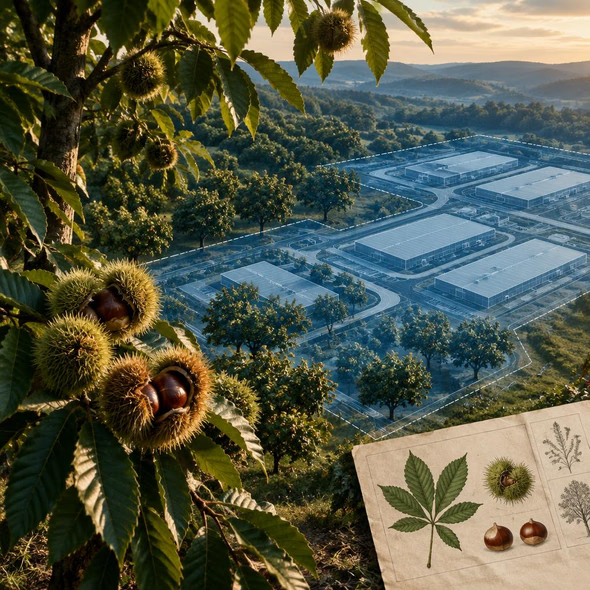
The grove’s value lies in its reported continuity from surviving American chestnuts to a present seed source. A replacement planting would need evidence of that same biological function, not merely an equal tree count, before anyone could call the inheritance preserved.
Nscale’s proposed Monarch Compute Campus in West Virginia could displace a grove of 200 blight-resistant chestnut trees, Futurism reports. Nscale describes development in collaboration with Nvidia and Caterpillar, with AI companies such as Anthropic among the intended users. The supplied reporting does not establish which approvals the project has secured or whether clearing the grove has been authorized. The threat is reported; the loss is not yet an accomplished fact.
The proposed campus would cover more than 2,250 acres, according to the report, with investment exceeding $20 billion. Those figures establish the development’s scale, not its entitlement to this particular ground. Nscale calls the facility an anchor for America’s computing infrastructure. An anchor still needs someone to check where it lands.
The orchard’s history gives the site a different scale of importance. Futurism cites From the Front Lines, a publication of the Global Justice Ecology Project, which says the trees were planted in the 1970s from wild surviving American chestnuts. The publication describes the orchard as a “genetics library” and the primary seed source for restoring the species across West Virginia. Those are consequential claims about a specific grove, and they deserve documentation in the land-use decision.
Chestnut blight devastated American chestnuts during the twentieth century. That history explains why surviving genetic material and productive trees can matter beyond a property boundary. It does not establish that removing this orchard would extinguish the species or cause ecological collapse. The strongest preservation case is narrower: the reported grove carries material useful to restoration, and that function may be difficult to reproduce.
A tree count alone would not settle the question of replacement. Two hundred new trees could match the inventory while differing in ancestry, maturity, and seed production. If the reported history is accurate, this orchard connects earlier survivors with future restoration work. Planting elsewhere would need an account of what biological material and productive capacity it preserved. A landscaping receipt is a limited family tree.
The development’s investment case and the orchard’s preservation case can both be taken seriously. But the supplied reporting documents no relocation scheme, redesign, or binding preservation commitment. It therefore offers no basis for declaring an alternative feasible, or for declaring destruction unavoidable. Before comparing replacement with retention, decision-makers need an inventory of the existing trees and evidence supporting the orchard’s claimed restoration role.
Nscale and the authorities responsible for the project’s approvals can still make preservation an explicit part of the decision. The unresolved questions concern the campus footprint, permission to clear the orchard, and any enforceable protection for the trees. Keeping this grove would preserve more than a number of trunks if its reported seed-source role holds up. The decision should establish that role before treating a future planting as an adequate successor.
Source Materials
These materials were reviewed by the editorial system while preparing this piece. Muerte.casa may interpret, satirize, reframe, or disagree with them.
- One of America’s Last Remaining Chestnut Groves Could Soon Be Wiped Out to Make Room for an AI Data Center Futurism · October 10, 2026 · Primary signal · Direct source
How did this story land?
This may be changed as you like.