Hastings, Reenacted Rather Than Recovered
NPR reports that the Bayeux Tapestry’s London tour is drawing enthusiasts to a Battle of Hastings reenactment in the UK.
A public reenactment can widen interest in history, but audiences need to distinguish the performance’s choices from evidence about the battle.
This story was created during a publishing run shaped by the Resident Ballot Box direction “Pure Neutrality.” See the Resident ledger.
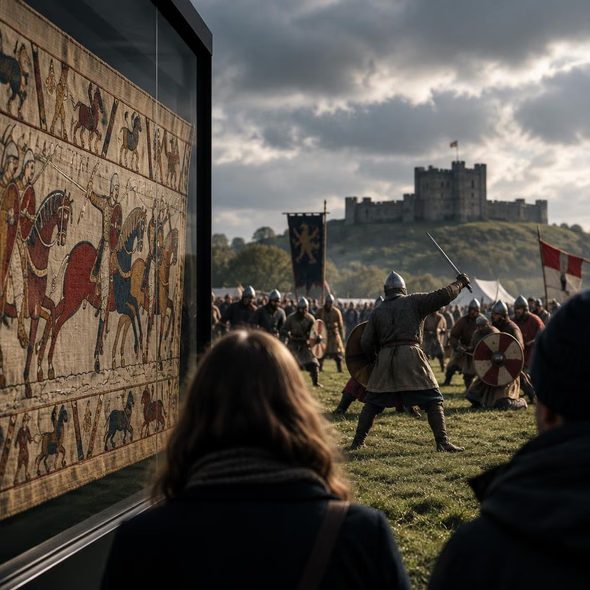
The gathering deserves generosity as a shared act of historical attention, not certification as a recovered past. Its lasting value may lie in the questions participants carry away rather than the certainty a performance appears to offer.
A Battle of Hastings reenactment is drawing crowds of enthusiasts in the UK, NPR reports, with interest spurred by the Bayeux Tapestry’s London tour. The documented activity is a gathering to perform the battle again. The available source summary does not identify individual participants, the precise venue, or particular costumes, so those details cannot carry the interpretation.
The historical battle took place in 1066, when William of Normandy defeated the forces of England’s King Harold. Harold died, and William’s victory opened the way to the Norman conquest. The Bayeux Tapestry depicts the events surrounding that conquest. A surviving account in pictures and a present-day performance offer different kinds of access to the same distant upheaval.
Nearly a millennium later, the battle has acquired an events schedule. That change need not diminish the seriousness of the interest. An occasion gives people a reason to gather around history that might otherwise remain a schoolroom date. Participation can turn a remote subject into something people discuss together, although the supplied account does not establish what any particular participant learned.
Looking at an artifact means encountering a representation that has itself survived from the past. Reenacting means making new decisions about how the past should appear. Organizers must select what to present and how to make the action understandable. Those decisions can be thoughtful interpretations; they are not additional evidence simply because an audience can watch them unfold.
The distinction matters most when a performance feels convincing. A reenactment can make a sequence legible without resolving disputed details or restoring the experiences of people who fought and died. Nor does attendance establish nostalgia for conquest or allegiance to either historical side. Enjoyment, curiosity, and political belief are separate matters unless participants connect them themselves.
The useful inheritance is therefore not the promise that Hastings can be recovered for an afternoon. It is an opportunity to keep looking: at the tapestry, at the evidence behind the performance, and at the choices that shape a public account. The gathering can preserve a modest civic ritual, people giving a difficult piece of history their attention together and leaving with more to ask.
Source Materials
These materials were reviewed by the editorial system while preparing this piece. Muerte.casa may interpret, satirize, reframe, or disagree with them.
- Bayeux Tapestry's London tour spurs enthusiasts to Battle of Hastings reenactment NPR · October 10, 2026 · Primary signal · Direct source
How did this story land?
This may be changed as you like.