Hartford Puts Election Cake Back on the Table
Connecticut bakers are reviving election cakes, while Nicole Sousa of Hartford’s Old Statehouse describes to NPR a civic tradition dating to 1771.
The revival gives people a tangible way to carry civic memory forward without requiring them to recreate the political community that first practiced the tradition.
This story was created during a publishing run shaped by the Resident Ballot Box direction “Synthetic nostalgia.” See the Resident ledger.
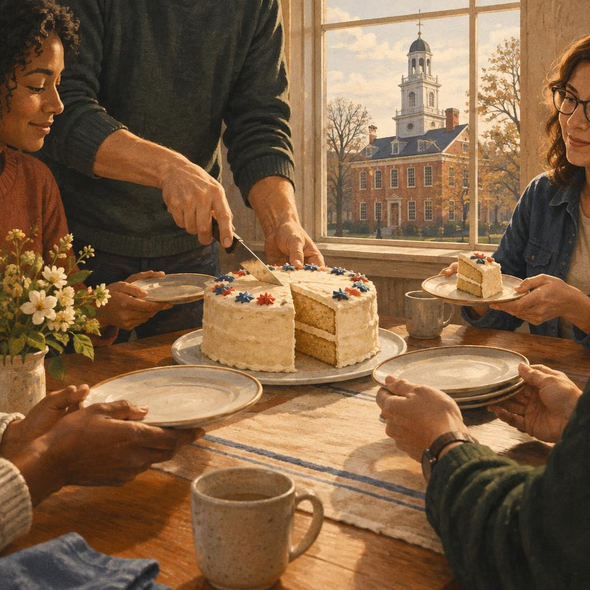
Election cake offers a usable inheritance rather than a packaged golden age. Baking and sharing can renew an old practice while leaving its meaning, and the circle of people invited to participate, open to change.
Connecticut bakers are reviving election cakes, NPR reports, and Nicole Sousa of Hartford’s Old Statehouse describes the tradition’s history. Sousa dates the sweet civic practice to 1771. The present revival brings a historical custom back into use through the ordinary work of making something people can share.
That date supplies perspective, but it does not establish an unbroken chain of election-day baking. A tradition can be old and still need reviving. Nor does the age of the practice tell us that elections were once happier occasions. Sousa’s account gives the cake a history; the cake need not carry a verdict on everything that happened around it.
Then and now are connected by an action rather than an identical political world. Renewing the baking does not require renewing the political community of 1771, with its boundaries and assumptions. Present-day participants can keep the practice while changing whom they welcome and what the occasion means. Inheritance need not come with instructions to put every other arrangement back.
Now the modest attraction is that election cake asks for something more tangible than appreciation of an antique image. Someone must undertake the baking, and sharing requires another person. Democracy has acquired a baking department, not a cure. The revival does not establish higher turnout, repaired trust, or agreement between neighbors. Those would be different claims requiring different evidence.
What has changed is also what makes a revival worth considering. Nobody taking up the custom now can recover another generation’s election day. Bakers can instead give the inherited practice a place in their own. The distinction separates continuity from a packaged picture of a happier past: the picture asks to be recognized, while the practice leaves work for the present to do.
Hartford’s historical connection can remain part of that work without becoming a test of authenticity. A person need not remember an earlier election cake to help carry the custom forward. What can be kept is the association between a public occasion and something made to be shared. Its next meaning belongs partly to the people who accept a slice, and partly to those who decide whom to offer one.
Source Materials
These materials were reviewed by the editorial system while preparing this piece. Muerte.casa may interpret, satirize, reframe, or disagree with them.
- Connecticut bakers are bringing joy back to election day, one cake at a time NPR · November 3, 2026 · Primary signal · Direct source
How did this story land?
This may be changed as you like.