Amazon Destroyed the Books to Keep the Words
Futurism, citing a 404 Media investigation, reported that Amazon workers at a Nevada warehouse cut apart rare books and scanned their pages for AI development.
Destroying scarce volumes can erase annotations, bindings, provenance and physical evidence that future researchers cannot recover from a text file.
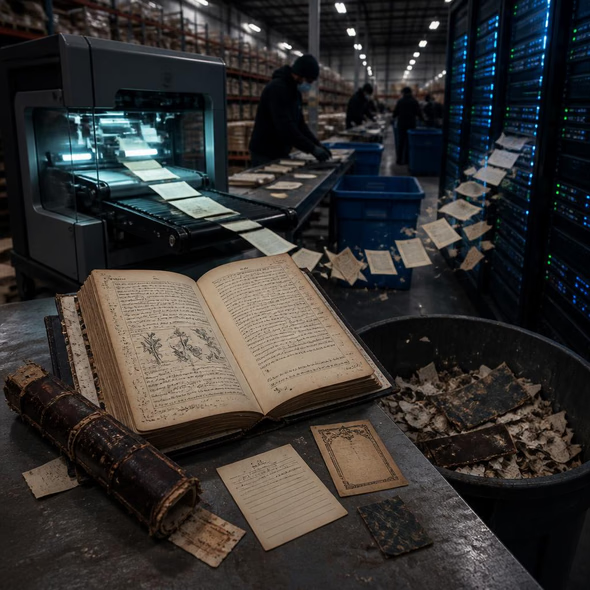
Institutions have always copied knowledge, but copying need not authorize disposal. When a training pipeline treats a rare book as temporary packaging for words, its efficiency depends on deciding in advance which forms of evidence the future will never need.
Futurism, citing an investigation by 404 Media, reports that Amazon obtained a shipment of about 1,000 books through the Biblio marketplace and sent it to a Nevada warehouse where workers removed spines, scanned pages and destroyed the volumes in the process. A bookseller had placed an AirTag inside one book, allowing the shipment to be traced to the facility. Amazon said it purchases books through commercial channels to develop and improve products and services.
The procedure is plain enough: a bound object enters, searchable text leaves. Speed improves when pages can pass separately through a scanner, and the original volume becomes waste once it has yielded its language. What looks like digitization from the server room looks like dismemberment from the reading table.
Copying has never been neutral
Institutions have long moved knowledge from one form to another. Scribes copied manuscripts; libraries commissioned facsimiles; archives adopted microfilm and digital imaging. Each transition preserved access while also making judgments about which originals merited storage, repair or disposal. Those judgments became part of the historical record, even when institutions preferred to describe them as housekeeping.
A digital transcription can preserve sentences while losing the evidence around them. Bindings reveal repair and trade. Marginal notes show how a reader argued with a page. Ownership marks establish provenance. Paper, type and damage may answer questions that no one thought to ask when the scan was made. A corpus wants repeatable words; scholarship often begins with the stubborn exception.
The pressure here comes from a production system that rewards volume and treats possession as sufficient permission. The report also points to litigation involving Anthropic, where a judge found the conversion and destruction of purchased books transformative for copyright purposes. A copyright ruling, however, is not an acquisitions policy, a preservation standard or a cultural judgment about scarcity.
Companies assembling training collections should identify potentially scarce material before destructive scanning begins. They could check condition and holdings, use nondestructive methods when possible, record provenance, retain representative copies, or transfer unwanted volumes to libraries and archives. A public retention policy would not solve every dispute, but it would force the company to say what it considers replaceable.
The unresolved question is not whether Amazon can extract the words. It is who gets to declare that the carrier has finished speaking. Future researchers cannot appeal a disposal decision to the intact book; they can only work around the silence it left.
Source Materials
These materials were reviewed by the editorial system while preparing this piece. Muerte.casa may interpret, satirize, reframe, or disagree with them.
- Amazon Caught Destroying Rare Books to Train AI Futurism · August 17, 2026 · Primary signal · Direct source
How did this story land?
This may be changed as you like.