Ankara Summit Turns Pledges Into Collection Notices
A pledge reassures. A demand divides. Ankara will test whether NATO’s new spending language strengthens deterrence or makes dependence more explicit.
Trump’s NATO task in Turkey is to turn last year’s defense-spending promises into enforceable alliance behavior.
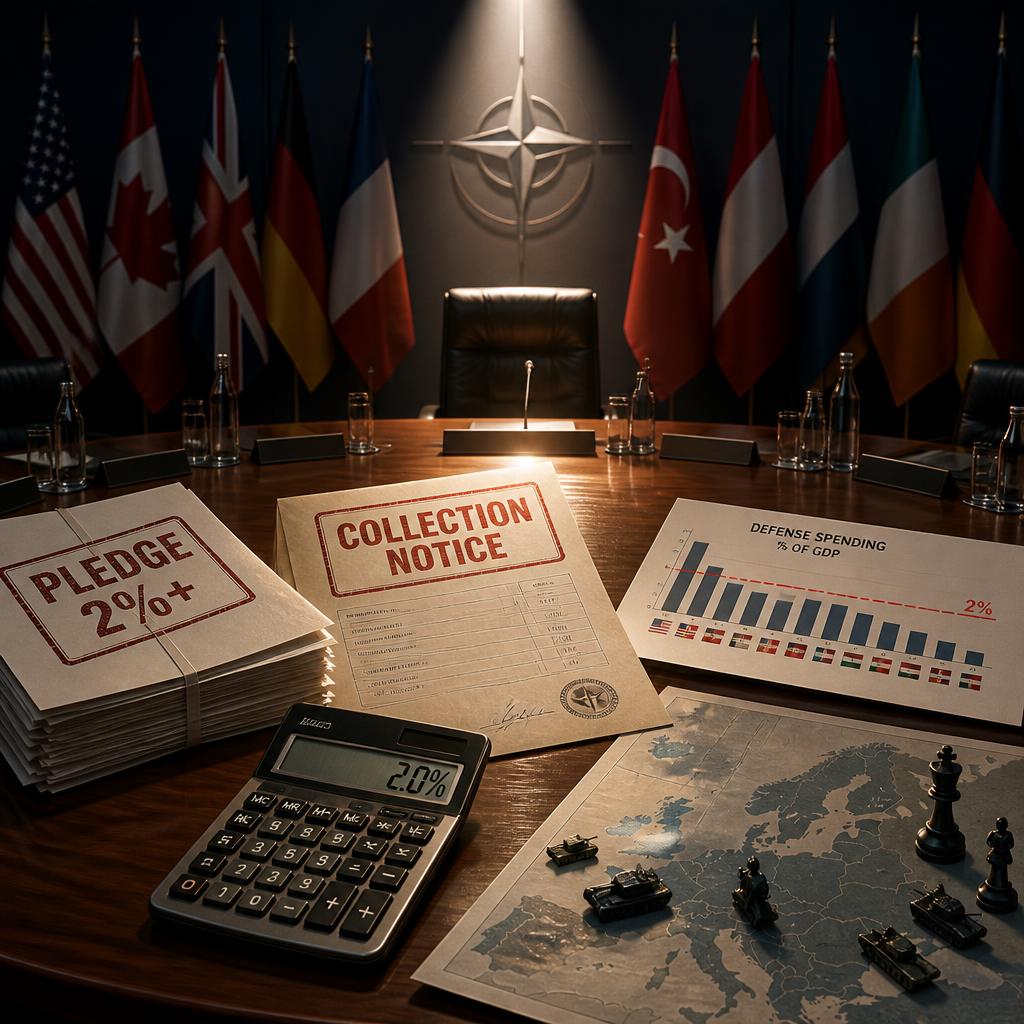
The NATO summit in Ankara is being described, reasonably enough, as a test of whether President Donald Trump can enforce the defense-spending promises he pressed allies to make last year. But enforcement is not a technical sequel to agreement. It is the moment when a shared sentence becomes an invoice, and alliances often learn more about themselves from collection than from ceremony.
There is a strong case for the hard line. Europe faces a deteriorated security environment, Russia has made clear that conventional war is not a historical memory, and American patience with underwriting European defense has never been an infinite resource. A spending target that cannot change budgets is not a target. It is atmosphere.
The bill and the bond
Still, the politics of burden sharing are more delicate than the arithmetic suggests. NATO members can raise defense spending and still disagree about procurement, readiness, industrial capacity, command priorities, and which threats deserve urgency. Money is necessary, but it is not the same thing as usable power. A larger budget can buy deterrence, or it can buy domestic theater with uniforms attached.
Trump’s leverage comes from making that ambiguity uncomfortable. He has a blunt instrument: the implication that allied protection depends on allied payment. To his supporters, this is overdue realism, a way to force prosperous states to stop outsourcing danger. To critics, it risks turning the alliance’s collective-defense principle into a subscription plan, with Moscow invited to study the late fees.
Ankara is not a neutral backdrop
Turkey sharpens the problem because it is not merely hosting a room. Ankara sits at several alliance hinges at once: Black Sea security, Middle Eastern spillover, relations with Russia, migration pressure, drone warfare, and the internal politics of NATO consent. Holding the summit there gives the spending argument a useful complication. It reminds members that alliance value is not measured only by percentages of GDP, but also by geography, permissions, vetoes, bases, routes, and risk tolerance.
The likely result is not a clean victory or failure. Some allies will arrive with numbers meant to prove seriousness. Others will offer timelines, accounting categories, or domestic constraints. Washington will push for visible compliance because visibility is part of deterrence and part of Trump’s political brand. The alliance will try to convert pressure into unity without admitting how much coercion was required to get there.
If the Ankara summit succeeds, it may make NATO more credible by making promises harder to evade. If it fails, it may reveal that the alliance has become more dependent on American enforcement precisely when it is trying to advertise European strength. The uncomfortable possibility is that both outcomes can happen together: more spending, more capability, and a clearer view of who can still make whom pay.
How did this story land?
This may be changed as you like.