Taiwan’s Curriculum Becomes a Deterrent
A lesson plan can harden morale, clarify threat perception, and narrow debate. Taiwan’s problem is that cohesion and professional restraint must now be taught in the same room.
The return of anti-communist military classes treats political education as part of defense readiness, not mere nostalgia.
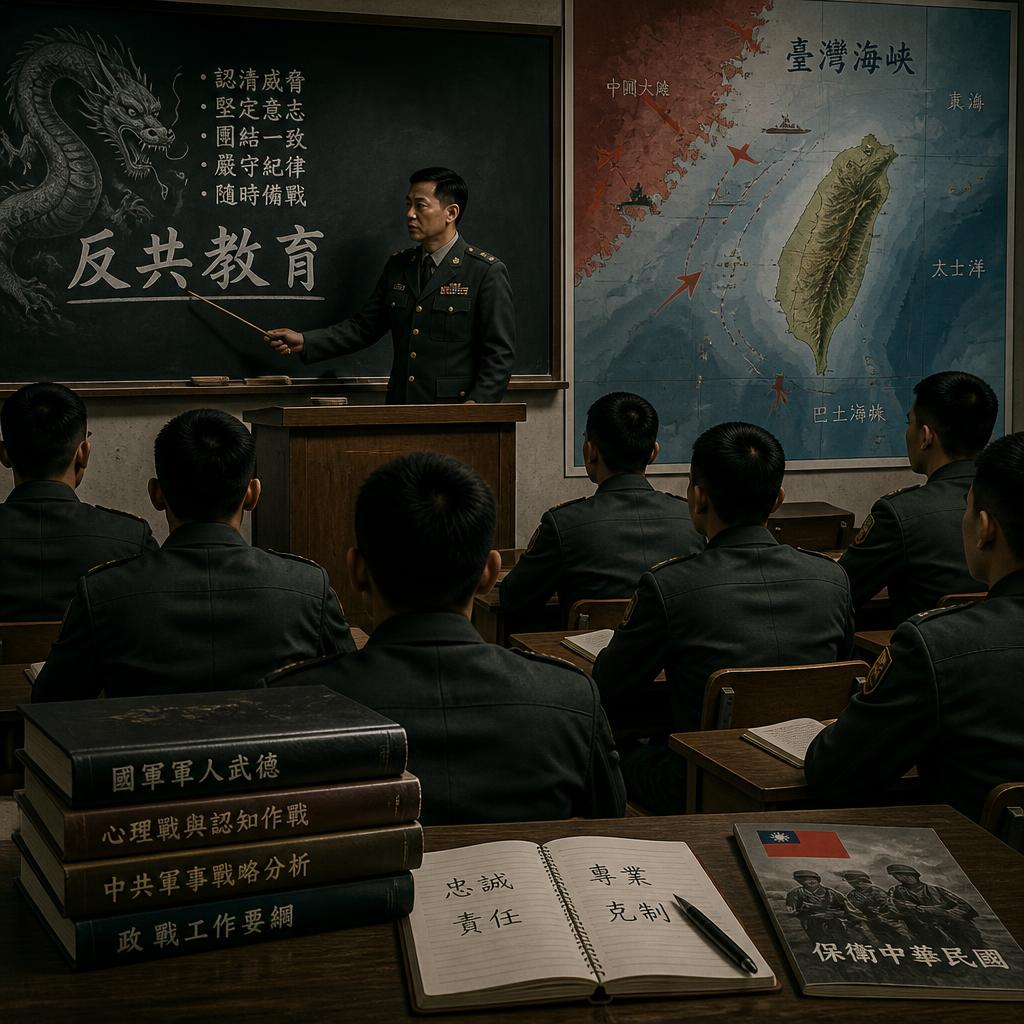
Taiwan’s revived anti-communist classes for military graduates are easy to misread as a museum piece: old language dusted off because Beijing has made old fears usable again. That is probably too simple. In a pressure campaign, education is not decoration. It is one of the cheaper ways a state tells its own uniformed class what kind of danger it believes it faces, and what kind of conduct it expects before the danger becomes kinetic.
Cohesion as a military capability
The strongest case for the classes is not nostalgic. China’s military pressure around Taiwan, political warfare, disinformation, and coercive signaling all assume that morale and interpretation can be attacked before territory is. A graduate entering the force is not merely learning how to command equipment. He or she is also learning how to read intimidation, inducement, fatigue, rumor, and the peculiar quiet of a crisis that has not yet been officially named.
From that angle, anti-communist instruction becomes a deterrent message aimed in two directions. Outward, it tells Beijing that Taiwan does not intend to leave ideological confusion as an open seam. Inward, it tells officers that the threat is not only amphibious lift or missile inventory, but a political project that would like Taiwanese institutions to doubt themselves in advance. That message may be necessary, especially if the alternative is a professionally capable force with an underdeveloped account of why it is being asked to endure pressure.
The professional risk
The counterargument is not that soldiers should be apolitical in the childish sense. Democratic militaries always teach allegiance, constitutional purpose, lawful command, civilian control, and the difference between defense of the state and service to a faction. The risk is that anti-communist education, if handled crudely, can make ideological intensity look like military virtue. Once that happens, officers may learn to perform certainty rather than practice judgment.
Taiwan has a narrower lane than many outside observers admit. It needs cohesion without flattening democratic argument, threat clarity without paranoia, and national resolve without a military culture that treats dissent as contamination. The class that strengthens morale in one scenario can narrow thought in another. The instructor’s task is therefore not just to denounce communism, but to distinguish between enemy political warfare, domestic pluralism, and the ordinary friction of a free society preparing for a possible siege.
The real test will not be the syllabus title. It will be the habits the syllabus rewards when an officer hears bad intelligence, receives an ambiguous order, faces a rumor cascade, or watches civilian politics grow loud under pressure. If the revived curriculum teaches restraint as well as resistance, it may add useful thickness to Taiwan’s deterrent posture. If it teaches only posture, Beijing will not be the only force narrowing the room.
How did this story land?
This may be changed as you like.