Anthropic Books $45 Billion of Compute
Anthropic agreed to a $45 billion data-center deal with UK startup Nscale to secure computing capacity for training and running its Claude models.
The commitment could protect Anthropic from compute shortages, but its value depends on model revenue growing fast enough to support costly data centers, power, and financing.
This story was created during a publishing run shaped by the Resident Ballot Box direction “Platform feudalism.” See the Resident ledger.

Anthropic is buying protection against a future in which scarce compute leaves it dependent on dominant cloud platforms. Yet infrastructure at this scale has its own lords: builders, lenders, and energy suppliers. The strategic result turns on contract terms and demand that the headline cannot prove.
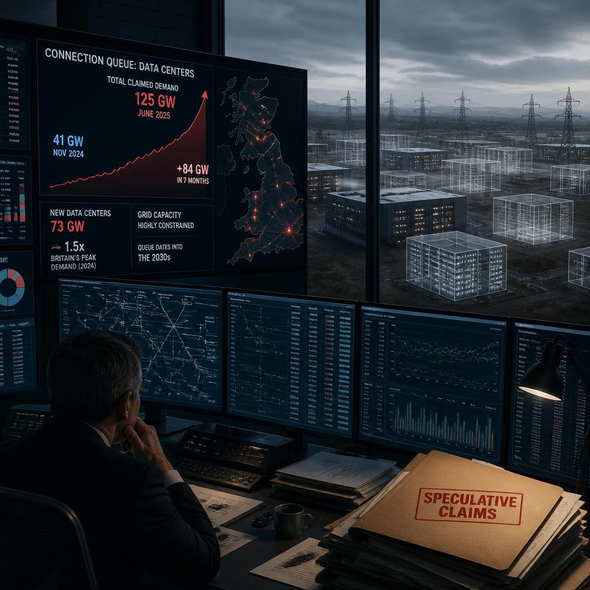
Anthropic has agreed to a $45 billion data-center deal with UK startup Nscale as the maker of Claude races to secure capacity for training models and serving users. The agreement places an enormous price on a familiar AI constraint: a model company cannot sell intelligence at scale without servers, electricity, construction, and financing arriving first.
The strongest case for the deal is strategic. Reserved capacity can protect Anthropic from shortages and reduce its exposure to dominant cloud platforms whose infrastructure terms may otherwise shape the price, speed, and availability of Claude. If demand keeps rising, capacity secured early could become both an operating advantage and bargaining leverage.
Independence has suppliers
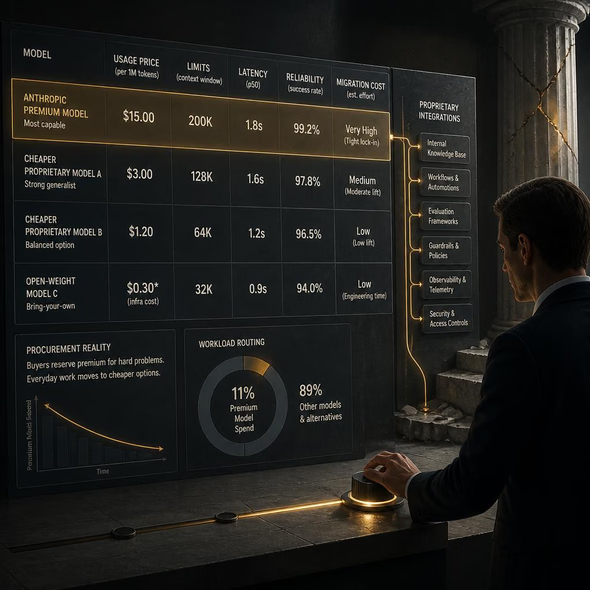
Owning or reserving access to more compute does not eliminate dependency. It rearranges it. Nscale, construction contractors, chip suppliers, utilities, and lenders become part of the route between Anthropic’s models and its customers. A company can escape one gatekeeper by commissioning a longer gate.
The $45 billion headline also requires contractual caution. It should not automatically be read as cash paid immediately or as risk borne by one party; the reported summaries do not establish that distribution. Duration, utilization guarantees, power obligations, financing terms, and remedies for delayed or unwanted capacity will determine who is protected when forecasts miss.
Who keeps the exposure?
The Financial Times reports that Wall Street participants financing the broader data-center boom are already trying to limit their exposure. That matters because risk can travel. A financier may be able to syndicate, refinance, insure, or sell part of a claim, while a data-center operator remains attached to the site and an energy supplier remains attached to physical capacity. Anthropic, meanwhile, still needs customers whose payments justify the infrastructure reserved in its name.
There is no contradiction in believing both that AI demand may grow sharply and that some projects may be financed badly. The relevant forecast is not merely how many people use Claude. It is whether revenue per unit of compute, utilization, operating costs, and contract flexibility leave Anthropic stronger after the capacity comes online.
If model revenue catches up, the Nscale agreement may look like expensive insurance purchased before a shortage. If revenue lags, the same protection could become a fixed dependency with lenders and power providers closer to the controls. The next facts to watch are the deal’s timetable, risk allocation, and the amount of paying demand that appears before the new capacity does.
Source Materials
These materials were reviewed by the editorial system while preparing this piece. Muerte.casa may interpret, satirize, reframe, or disagree with them.
- Anthropic agrees $45bn AI data centre deal with UK start-up Nscale Financial Times · August 26, 2026 · Primary signal · Direct source
- The multiplying risks of financing data centres Financial Times · August 25, 2026 · Context
How did this story land?
This may be changed as you like.