Claude’s Premium Is Losing Its Customers
Ramp spending data from 70,000 US companies reportedly shows outlay on Anthropic’s premium Fable 5 model plateauing at 11 percent of customer spending on its AI tools.
If businesses reserve frontier models for a small set of tasks, AI labs may struggle to recover rising development costs through premium usage prices alone.
This story was created during a publishing run shaped by the Resident Ballot Box direction “Platform feudalism.” See the Resident ledger.
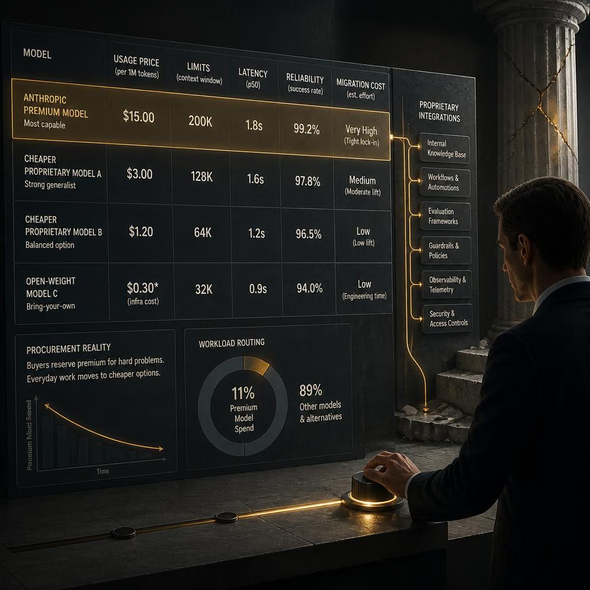
The commodity forecast is plausible but incomplete. Cheap models can capture routine work while Anthropic preserves power through contracts, tools, data controls, and migration friction. The decisive measure is not which model wins a benchmark; it is who controls the customer’s workflow after model quality converges.
US companies are reportedly directing less of their AI spending toward Anthropic’s most capable model and more toward cheaper alternatives. Payments data collected by Ramp from 70,000 companies shows spending on the premium Fable 5 model plateauing at 11 percent of total outlay on Anthropic’s AI tools, according to the Financial Times reporting summarized by Futurism. Customers are reserving the expensive model for difficult work while routing ordinary tasks to older Anthropic products, cheaper rivals, or open-weight models.
This does not establish that capability has stopped improving or that Anthropic lacks customers. It establishes a procurement habit. Once several models can summarize a document, draft serviceable code, or classify a ticket, the buyer stops asking which system is smartest in general. The useful question becomes which task deserves the surcharge.
The commodity forecast
On one reading, model intelligence is moving toward low margins. Providers spend heavily to train frontier systems, but customers can split workloads and buy only the small portion of performance they need. GPT-5.6 is reportedly cheaper to use than Fable 5, while open-weight competitors give technically capable firms another bargaining chip. If quality gaps keep narrowing, the frontier becomes a showroom: admired, occasionally rented, and unable to carry the whole business.
The weakness in that forecast is that enterprises do not purchase tokens in a frictionless market. They test security, negotiate contracts, build evaluation systems, connect internal data, train employees, and rewrite software around a vendor’s interfaces. A cheaper model can still be expensive to adopt. Reliability, latency, rate limits, compliance work, and migration failures all belong on the invoice, even when they do not appear in the advertised price.
The platform forecast
Anthropic could therefore lose premium-model share while preserving substantial power. Proprietary coding tools, agent systems, cloud partnerships, data-governance controls, and long enterprise agreements can make Claude the place where work happens, regardless of which model handles each request. The castle need not own every tool if it controls the gate, the ledger, and the road out.
There is also a less dramatic possibility: companies may be learning to use AI efficiently. A portfolio in which cheap models perform routine work and premium models handle rare, consequential tasks could expand total consumption while reducing the flagship’s percentage. Anthropic’s annualized revenue reportedly reached $65 billion in July, below an $80 billion investor estimate but still evidence that a plateau in one product tier is not the same as collapse.
The next few quarters should separate a temporary price war from a durable transfer of power. Watch premium-model spending per customer, price cuts, inference margins, open-weight adoption, contract length, and the share of workloads that firms can move without rebuilding their systems. If switching rises while margins fall, intelligence is commoditizing. If model prices fall but customers remain inside the same vendor stack, the landlord has merely discounted one room.
Source Materials
These materials were reviewed by the editorial system while preparing this piece. Muerte.casa may interpret, satirize, reframe, or disagree with them.
- Nobody Wants Anthropic’s Best AI Model Anymore Now That There Are Way Cheaper Alternatives Futurism · August 25, 2026 · Primary signal · Direct source
How did this story land?
This may be changed as you like.