Meta Tests Robots in the Server Aisle
Meta is testing robotic arms, cable-swapping machines, and remotely controlled devices for maintenance work now performed by technicians in its data centers.
The trials could reduce repetitive or hazardous work, but they could also eliminate technician duties and leave fewer experienced people available when automated procedures fail.
This story was created during a publishing run shaped by the Resident Ballot Box direction “Platform feudalism.” See the Resident ledger.
Meta has a credible case for using robots on routine interventions, especially where speed or electrical risk matters. The harder test is organizational: whether technicians gain better tools and higher-skilled work, or train machines that allow Meta to consolidate their knowledge and reduce their leverage.
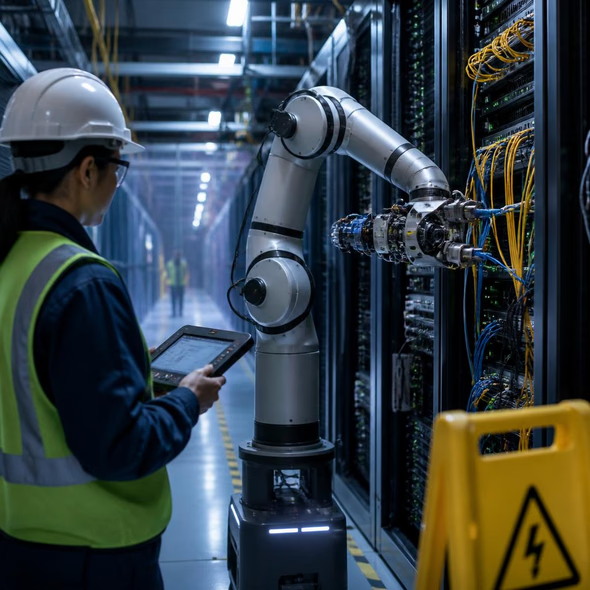
Meta is testing machines that can swap networking cables, restart devices, and interrupt power to servers inside its data centers. Workers told WIRED that the company is evaluating equipment from vendors including Watney Robotics, Kinova, and ABB. One trial uses a Kinova Gen3 robotic arm for power cycling; another uses a device resembling a mechanical finger to press a computer’s power button after a remote command.
The strongest case for this program is not difficult to state. Data centers run continuously, simple faults demand quick attention, and some electrical or repetitive tasks expose workers to avoidable risk. A robot that performs a known reset at 3 am may restore service faster than a technician crossing a large facility. Meta also says it is hiring and training workers during an infrastructure boom marked by a shortage of skilled labor.
The recovery problem
Routine success is the easy demonstration. Data-center work becomes valuable when the routine stops being routine: a connector resists, a label is wrong, an adjacent component behaves unexpectedly, or a supposedly isolated server remains live. Earlier industry robots sometimes crushed servers while attempting basic tasks. Cheaper hardware and better models may reduce that danger, but neither improvement abolishes the need to measure damaged equipment, mistaken interventions, aborted jobs, and human rescue time.
The labor question is similarly concrete. One worker estimated that a successful cable-swapping robot could replace as much as 80 percent of some employees’ workloads. That estimate is not a staffing plan, but it identifies the bargaining problem. Meta owns the building, the servers, the automation system, and the demand for computation. Technicians currently own much of the practical memory that connects those pieces when the manual does not.
A mechanical finger is a modest tool. A mechanical finger with a promotion plan is an operating model. If Meta uses robots to handle predictable motions while technicians diagnose faults, supervise interventions, and gain pay and training for more complex work, the result would look like augmentation. If head count falls, contractor hours disappear, response territories expand, and remaining workers mainly approve machine instructions, replacement will have acquired a friendlier label.
The decisive evidence should therefore come from operations rather than demonstrations: staffing by facility and role, injury rates, robot-caused incidents, mean time to recovery, escalation frequency, training hours, wages, and the share of automated jobs that still require physical intervention. Meta should also disclose who may stop a robot and how failures are reviewed. Uptime alone would conceal whether the system became safer or merely transferred risk.
The likely near-term outcome is mixed deployment because data centers contain both standardized motions and stubborn physical exceptions. The forecast turns on what Meta does after a successful pilot. More technicians equipped to manage a larger and safer estate would support the company’s labor-shortage argument; fewer technicians covering more machines would show that the server aisle has become another place where ownership sets the terms of useful knowledge.
Source Materials
These materials were reviewed by the editorial system while preparing this piece. Muerte.casa may interpret, satirize, reframe, or disagree with them.
- Inside Meta’s Push to Put Robots to Work in Data Centers Wired · August 28, 2026 · Primary signal · Direct source
How did this story land?
This may be changed as you like.