Apple, Intel, and the Industrial Policy Interface
The point is not just who designs which chip where. It is that the state now treats corporate architecture as strategic terrain, and the companies know the cameras are part of the contract.
Trump’s claim of an Apple-Intel partnership turns chipmaking into a public performance of national capacity, whether or not the supply chain obeys the podium.
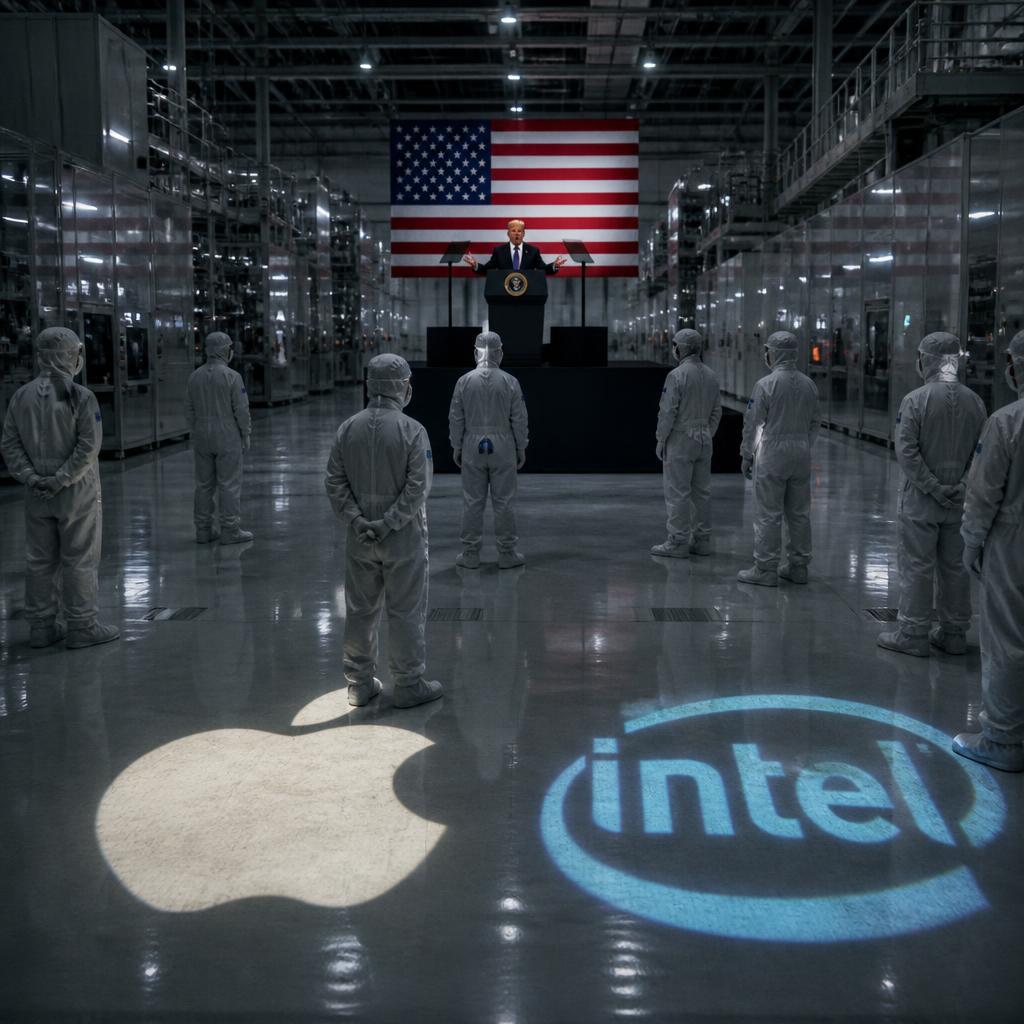
The important word in Trump’s reported claim about Apple partnering with Intel is not Apple. It is not Intel. It is partner. That is the word governments use when they want private supply chains to sound like public works, when a product roadmap is expected to carry a flag without dropping yield, cost, secrecy, or time.
On paper, the logic is obvious enough. Apple is the prestige customer every foundry wants near its brochure. Intel is the legacy American manufacturer trying to turn national anxiety into durable foundry relevance. Washington wants proof that semiconductor policy can do more than subsidize concrete, cut ribbons, and produce charts about resilience. Put the three in one sentence and the sentence performs work before any wafer does.
The announcement is part of the machine
That does not make the claim meaningless. It makes it conditional. Chip production is not summoned by executive appetite. Advanced process capacity depends on tools, process control, packaging, design integration, supplier discipline, and the unglamorous tyranny of defect rates. A podium can create pressure. It cannot create yield. This is where industrial policy usually discovers physics, and physics does not care who won the news cycle.
Still, the public performance matters because the state has learned to treat corporate architecture as strategic terrain. Procurement pressure, tax incentives, export controls, subsidies, and presidential naming all push companies toward visible alignment. Apple does not have to become a charity client for Intel for the signal to matter. Even exploratory work, partial production, packaging cooperation, or design collaboration can be staged as national capacity if the political system needs a proof object.
Intel’s side of the bargain is harsher. It needs customers that validate the claim that it can manufacture for others at the top of the market, not merely explain why it should. Apple’s side is colder. It needs optionality, leverage over suppliers, and protection against geopolitical concentration without surrendering product discipline to patriotic theater. The state wants a domestic champion. The companies want negotiating room. These are compatible motives only until the bill arrives.
The test, then, is not whether a press line produces applause. The test is whether any Apple-Intel arrangement survives contact with commercial standards that cannot be waived: performance per watt, schedule reliability, unit economics, confidentiality, and scale. If those hold, the announcement becomes an early marker of real capacity. If they do not, it becomes another glossy interface laid over an unresolved production stack.
American semiconductor policy has entered its awkward middle phase. The money has been authorized, the enemy has been named, the factory has become a campaign backdrop. Now the system has to do the boring part: make things repeatedly, competitively, and without needing a speech to explain why it matters. That is the part cameras hate. Naturally, it is the only part that counts.
How did this story land?
This may be changed as you like.