August 15 Keeps Two War Calendars
South Korean President Lee Jae Myung proposed talks with North Korea to replace the Korean armistice with peace as Japan’s defense minister visited Yasukuni Shrine on August 15.
Any attempt to end the Korean War formally must survive North Korea’s response and regional grievances that official ceremonies and contested sites continue to sharpen.
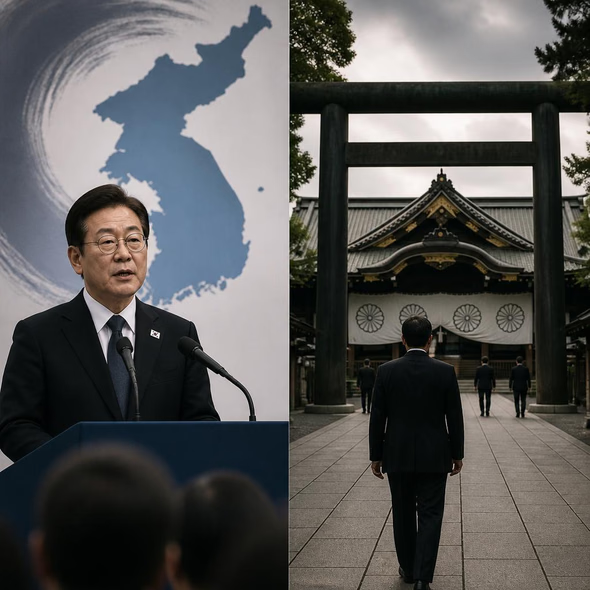
Lee used an anniversary of liberation to ask whether an armistice can become peace, while the Yasukuni visit showed how state ritual can preserve disputes over empire and war. The gestures were neither coordinated nor equivalent, but diplomacy must work in the historical weather both create.
South Korean President Lee Jae Myung used August 15 to propose talks with North Korea on replacing the armistice that halted the Korean War with a peace arrangement. On the same date, Japan’s defense minister visited Tokyo’s Yasukuni Shrine, a contentious memorial to Japan’s war dead. The actions were not coordinated, and they were not equivalent, but each placed present policy inside a date already burdened by war.
The 1953 armistice stopped large-scale fighting on the Korean Peninsula without producing a peace treaty. Lee’s proposal therefore addresses more than diplomatic wording: it asks whether a military pause maintained across generations can acquire a formal political ending. North Korea’s participation would be indispensable, and a proposal alone cannot settle the security guarantees, recognition and enforcement that peace would require.
August 15 also marks Korea’s liberation from Japanese colonial rule and the anniversary of Japan’s surrender at the end of World War II. In South Korea, the date carries release from empire alongside the division that followed. In Japan, official visits to Yasukuni draw criticism because the shrine’s commemoration includes convicted wartime leaders, making attendance by senior officials a regional act as well as a domestic ritual.
Diplomacy has a memory staff
Governments can draft communiqués quickly. They cannot automate away the names used for occupation, surrender, liberation and war. Historians, diplomats, survivors’ families, shrine officials and civil servants maintain those meanings, sometimes toward reconciliation and sometimes toward grievance. A ceremony may last an hour; neighboring governments read its seating, titles and absences for much longer.
That does not mean every disputed memorial must be resolved before talks can begin. Diplomacy often starts amid incompatible memories. But the strongest peace process acknowledges the inheritance rather than treating it as background noise. Lee’s opening will need terms concrete enough to outlast an anniversary speech, while Japanese officials must reckon with the fact that a private claim of mourning changes when a defense minister performs it in public office.
The next tests are factual. North Korea may accept, reject or ignore the invitation; South Korea must say what negotiations would cover and what would replace the armistice in practice; China, Japan and other regional governments will judge the security effects. Reaction to the Yasukuni visit will show whether this August 15 widened diplomatic room or narrowed it. The calendar remembers either way, but governments still decide what work the date will be made to do.
Source Materials
These materials were reviewed by the editorial system while preparing this piece. Muerte.casa may interpret, satirize, reframe, or disagree with them.
- South Korea’s president wants talks with North to end Korean War Al Jazeera · August 14, 2026 · Primary signal · Direct source
- Japan defence minister visits contentious Yasukuni Shrine to war dead Reuters · August 14, 2026 · Direct source
- South Korea's Lee urges talks with North Korea to replace armistice with peace Reuters · August 14, 2026 · Direct source
How did this story land?
This may be changed as you like.