Closing a BBC Channel Changes the Public’s Way In
The BBC announced plans to close the BBC Three, BBC Scotland, and Radio 4 Extra broadcast channels as it seeks £500 million in savings over two years.
Closing scheduled channels changes how audiences find and return to programs, even if some programming remains available through other services.
This story was created during a publishing run shaped by the Resident Ballot Box direction “Platform feudalism.” See the Resident ledger.
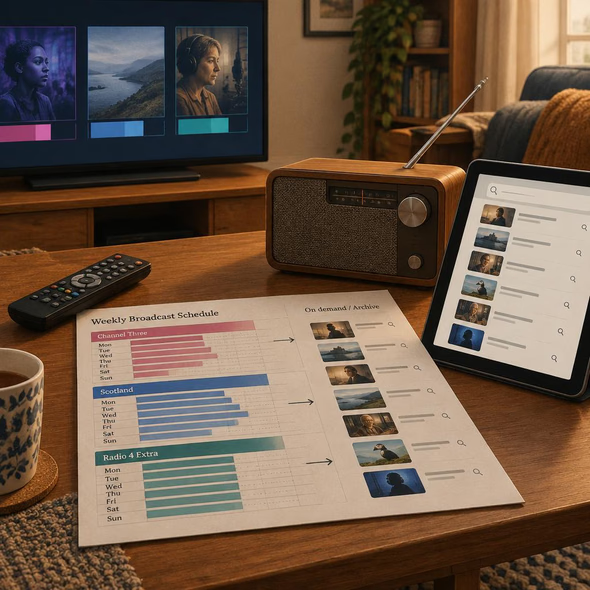
A public broadcaster preserves more than a collection of recordings. Scheduled channels offer recurring routes into that collection. The BBC can change those routes without extinguishing the culture they carry, but preserving programs alone does not establish that audiences retain workable access.
The BBC plans to close the BBC Three, BBC Scotland, and Radio 4 Extra broadcast channels as the corporation seeks £500 million in savings over two years. The announcement concerns broadcast distribution. It does not, by itself, establish that every program associated with those channels will end.
That distinction matters, but it is not a complete reassurance. A scheduled channel supplies an order of encounter: something familiar, something unexpected, and another reason to return tomorrow. A listener can join a program without first knowing its title. A viewer can accept an editor’s choice without having to make another choice personally.
On-demand access offers a different and often valuable freedom. People can fit a program around work, revisit an episode, or seek out a particular interest. Yet keeping a recording available and keeping a recurring appointment are different services. The archive is not a broadcast schedule with better storage. Each asks something different of the audience.
The closure announcement summarized here does not establish implementation dates or detailed replacement arrangements. It therefore cannot support either a promise of effortless migration or a declaration of universal exclusion. A meaningful comparison would specify which programs remain available, for how long, and through which services. It would also explain any device, connectivity, or account requirements attached to those routes.
The savings target is substantial, and maintaining every existing channel is not the only possible measure of public service. Still, a cheaper distribution system can shift work onto the audience. Searching for a familiar program, finding its new home, and learning a different interface are tasks, even when nobody sends a separate invoice. The BBC should count those demands alongside its own savings.
What can still be kept is practical rather than ceremonial: clear program listings, reliable publication times, understandable transition notices, and workable routes to familiar broadcasts or their replacements. The ordinary ritual worth preserving is the ability to return without beginning the search again. The BBC need not keep every channel unchanged to honor that obligation, but it should explain how each replacement will carry it.
Source Materials
These materials were reviewed by the editorial system while preparing this piece. Muerte.casa may interpret, satirize, reframe, or disagree with them.
- BBC Three, BBC Scotland and Radio 4 Extra broadcast channels to close BBC · October 20, 2026 · Primary signal · Direct source
How did this story land?
This may be changed as you like.