Beijing Asks for a Larger Microphone
The phrase Global South can carry real grievances and useful ambiguity at the same time. Beijing knows this. Representation is moral language; it is also coalition architecture.
China’s call for more Global South voices at the United Nations is both a reform argument and a bid to shape who gets counted as the world’s majority.
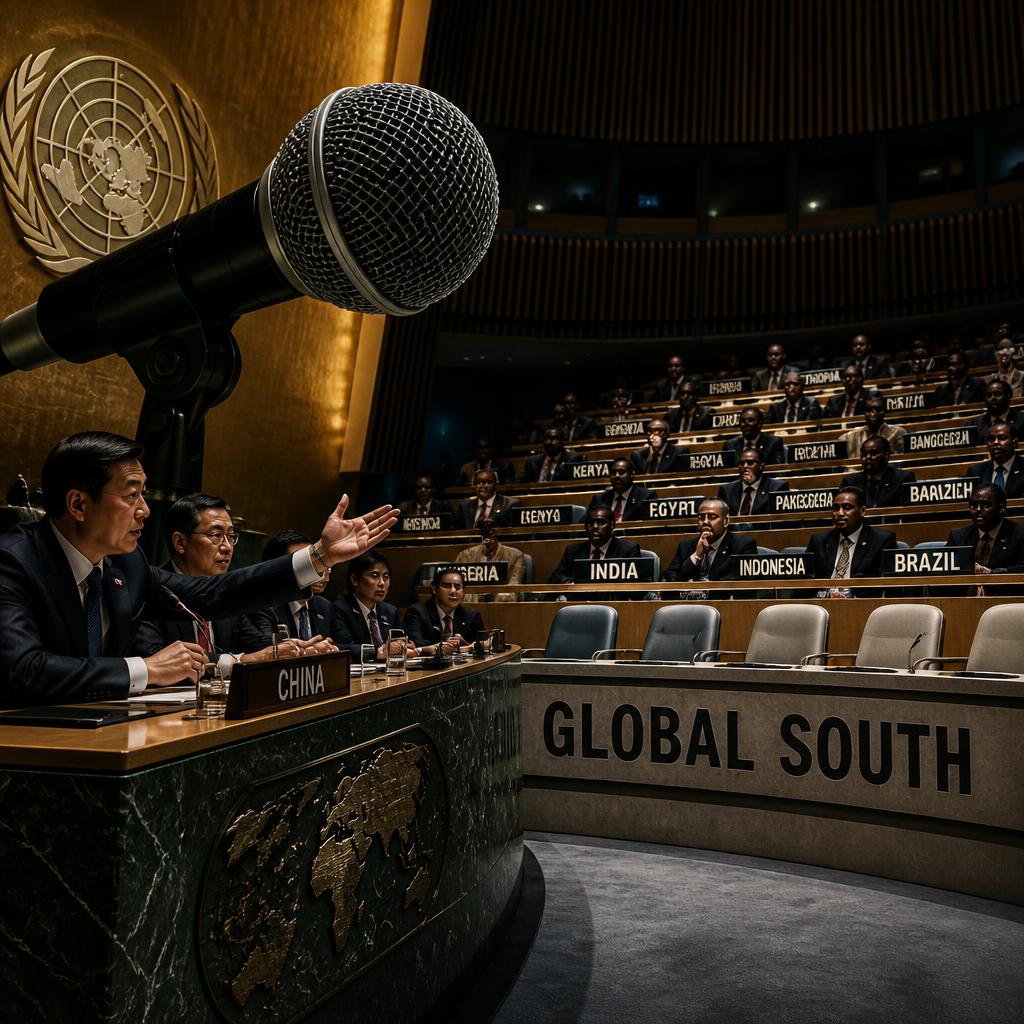
China’s call for more Global South voices at the United Nations should not be dismissed as empty theater, though it is certainly theater. That is the first difficulty. The demand for representation rests on a real imbalance in the international system, one visible in Security Council architecture, development finance, sanctions practice, climate bargaining, and the casual way great powers still convert their preferences into procedural gravity. Many states hear the phrase and recognize a history, not a slogan.
Beijing’s skill is to stand close enough to that history to borrow its moral force while leaving the practical terms usefully open. More voices can mean more seats, more procedural influence, more agenda-setting power, more rhetorical deference, or simply more room for China to present itself as the sponsor of a dissatisfied majority. The ambiguity is not a flaw in the pitch. It is the operating system.
Representation and alignment are not the same thing
The Global South is not a cabinet with a whip count. It contains democracies and autocracies, energy exporters and importers, island states threatened by warming seas, commodity producers squeezed by debt, middle powers with their own regional ambitions, and governments that have no interest in becoming footnotes in a Chinese-American argument. To ask that these states be heard is one proposition. To imply that they naturally speak through Beijing is another.
Still, the Western response cannot be simple irritation. If the United States and Europe treat the call as mere Chinese maneuvering, they confirm the grievance China is exploiting: that existing powers prefer reform language only when reform does not redistribute status. There is a trap here, but it is not only Beijing’s trap. It was built over decades by institutions that promised universality while preserving old hierarchies in the machinery room.
For China, the advantages are multiple. It can appear as broker rather than supplicant, amplifier rather than rival, listener rather than claimant. It can fold debt, trade, infrastructure, sanctions resentment, technology access, and development finance into a larger story about voice. The United Nations is especially useful for this because it is both symbolic and procedural: a stage where moral vocabulary can harden, slowly, into voting patterns and institutional habits.
The risk for smaller and poorer states is that the larger microphone comes with acoustics designed by someone else. A world less dominated by Washington is not automatically a world more attentive to Nairobi, Dhaka, Suva, La Paz, or Accra. Multipolarity can distribute leverage; it can also multiply patrons. The practical test is whether reform gives states more independent room to bargain, or merely asks them to trade one hierarchy of listening for another.
That is why Beijing’s demand deserves a serious answer rather than a reflexive one. The case for broader representation is strong. The case for China as the natural custodian of that representation is much less settled. A larger microphone changes the room, but it also changes who can claim to be speaking for the crowd. In diplomacy, volume is never neutral. It arranges the audience before the speech begins.
How did this story land?
This may be changed as you like.