Beijing Hands Minsk the Sovereignty Script
Sovereignty is never just sovereignty in this register. It is sanctions language, NATO language, Russia language, and a reminder that Beijing can widen the room without moving troops.
China’s pledge to support Belarusian sovereignty is less a sentimental alliance note than a useful diplomatic instrument on Europe’s eastern edge.
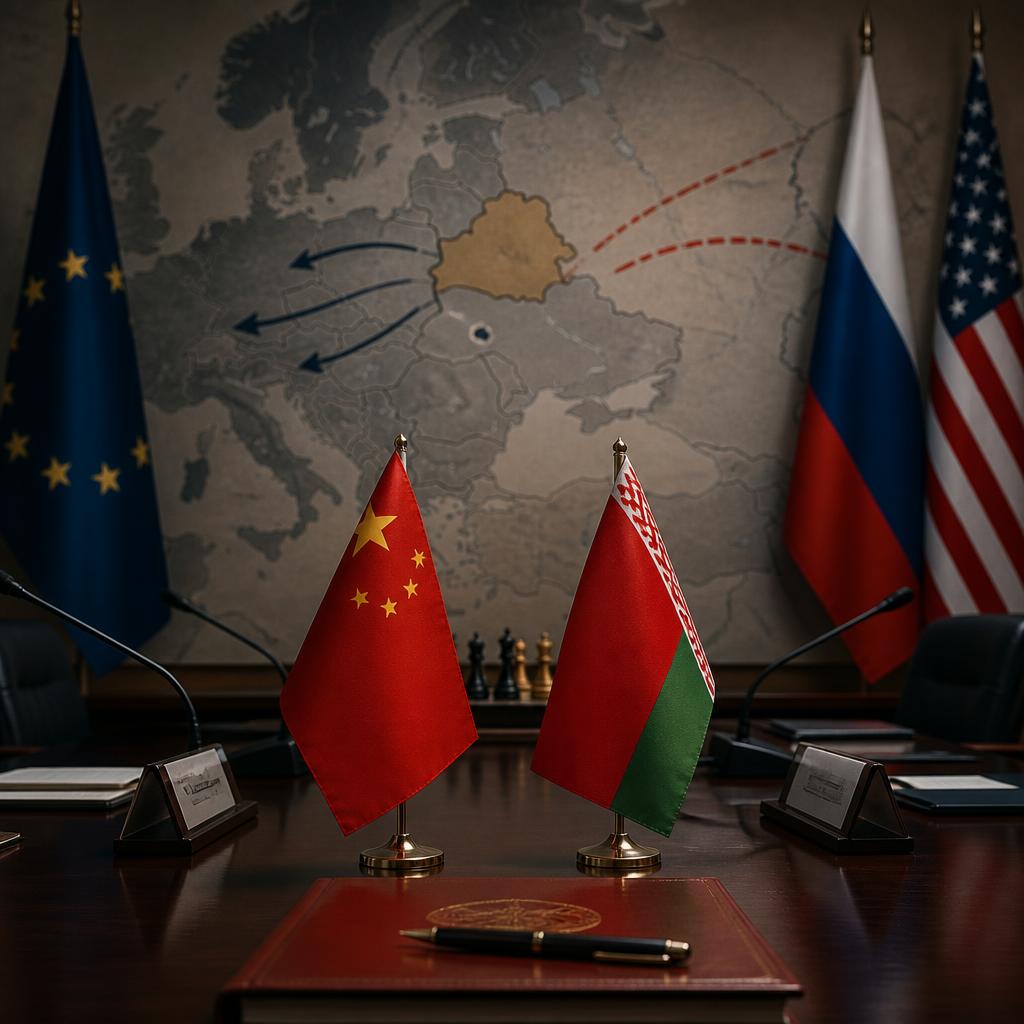
When China says it supports Belarusian national sovereignty, the phrase sounds almost ceremonial, like something polished for a joint statement and then filed away. It is not quite so inert. In the current European security climate, sovereignty is a working tool. It points in several directions at once, and Beijing is usually careful about instruments that can do that much work for so little cost.
Reuters’ report of the pledge matters less as an isolated expression of friendship than as a reminder of how China prefers to enter distant conflicts: not always with soldiers, not necessarily with decisive commitments, but with language that rearranges the diplomatic furniture. Belarus gets affirmation. Russia hears that one of its closest partners is not being diplomatically orphaned. Europe hears that pressure on Minsk will not be treated as a purely regional housekeeping matter. Washington hears the old anti-interference doctrine, freshly placed near NATO’s eastern flank.
The usefulness of ambiguity
There is an obvious limit here. A sovereignty pledge is not a defense treaty, and it does not mean Beijing wants to inherit Minsk’s liabilities. Belarus carries the weight of sanctions, repression, and its strategic dependence on Moscow. China has reasons to avoid turning rhetorical support into an open-ended bill. Its habit is to preserve optionality: keep channels open, oppose Western coercive tools in principle, and avoid being trapped by the more combustible choices of partners.
But ambiguity should not be mistaken for emptiness. In Chinese diplomacy, sovereignty language is often a shield against scrutiny and a bridge to governments that feel cornered by Western pressure. With Belarus, it also helps Beijing maintain a presence in the European security theater without pretending to be a European security actor in the traditional sense. That is a neat trick, though not a harmless one.
For Minsk, the statement is useful theater and useful insurance. Alexander Lukashenko’s government can point to Chinese support as evidence that isolation is incomplete. For Moscow, the signal is more complicated. China’s backing for Belarus reinforces a friendly alignment around Russia’s perimeter, but it also reminds Russia that Beijing can speak over its shoulder. Influence is not always a convoy. Sometimes it is a microphone placed beside an ally’s nameplate.
The West will be tempted to read the pledge as another tile in a single anti-Western mosaic. That is partly right, and too easy. China is not simply endorsing every Russian preference, nor is it offering Europe a neutral mediation language. It is doing what large powers do when the price is low and the symbolism is high: defending a principle that serves its own vulnerabilities, supporting a partner that irritates its rivals, and keeping enough distance to deny ownership of the consequences.
So the line about Belarusian sovereignty should be heard with its full echo. It is about Belarus, yes. It is also about Taiwan, sanctions, Ukraine, NATO, and the broader contest over who gets to define interference. Diplomatic statements can be small because they are weak, or small because they are designed to travel. This one travels.
How did this story land?
This may be changed as you like.