Beijing Receives the Pre-Meeting Message
Diplomacy rarely starts at the table everyone watches. It starts in the adjacent room, where anxious partners ask what they can preserve before larger powers begin trading weather.
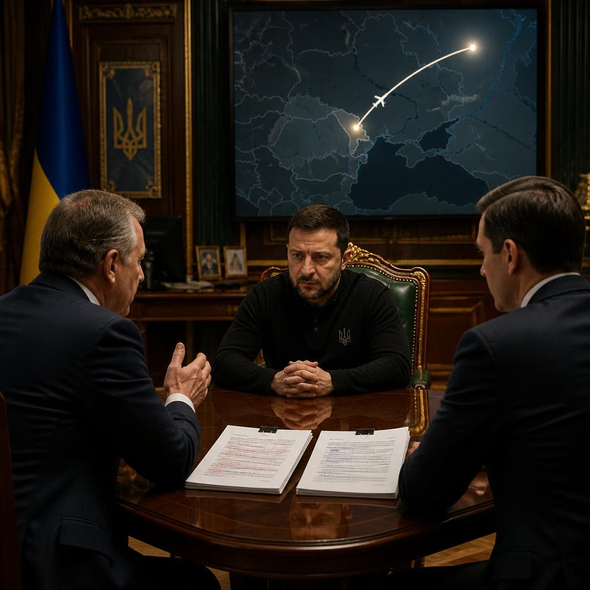
Iran’s foreign minister meeting China’s top diplomat before Trump’s Beijing trip shows how secondary powers try to shape the room before the principal negotiation begins.

The reported meeting between Iran’s foreign minister and China’s top diplomat, coming a week before Trump’s expected trip to Beijing, is not a side note. It is the side note that tries to become part of the main text. Much of diplomacy is like this: not the summit photograph, not the handshake, not the public sentence about frank and constructive talks, but the earlier effort to make sure one’s interests are already sitting in the room when the principals arrive.
Tehran has reason to do that work. If Washington and Beijing are preparing to bargain across trade, security, technology, sanctions, oil flows, and regional influence, Iran cannot assume it will be discussed only as itself. It may become leverage, irritant, concession, warning, or proof of seriousness. Smaller powers are not powerless in such moments, but they are exposed to translation. Their urgent local needs can become somebody else’s flexible clause.
The adjacent room matters
For Iran, the purpose of meeting Beijing before Trump arrives is likely insulation. That does not mean China can or will guarantee Tehran’s preferred outcome. It means Iran can press its case before the larger choreography begins: remind Beijing of energy ties, of shared resistance to US pressure, of the usefulness of keeping American demands from becoming too cleanly bilateral. In crude terms, Tehran wants to make itself harder to trade over.
For China, receiving the message has its own utility. Beijing can signal that it has relationships Washington must account for, without necessarily promising Iran more than ambiguity. This is one of China’s durable advantages: it can present itself as a stabilizer, a counterweight, a commercial partner, and a strategic complication, sometimes in the same afternoon. The performance does not require dramatic movement. Sometimes leverage is just the visible ability to take meetings others would prefer you not take.
Washington, then, enters a negotiation already crowded. That is not unusual, and it is not automatically bad. Great-power talks are always haunted by clients, partners, adversaries, markets, domestic audiences, and military calendars. The danger is that a summit framed as a bilateral contest becomes overconfident about what bilateral pressure can settle. The United States may want China to restrain Iran, or may want to show that Beijing’s influence has limits. China may want credit for restraint without paying the full cost of enforcement. Iran may want protection without becoming dependent on a protector’s convenience.
The uncertainty is the point. A pre-summit meeting does not tell us what bargain will be made; it tells us which actors fear being left outside it. Diplomacy rarely begins at the table everyone watches. It begins in the adjacent room, where anxious governments ask what can be preserved before larger powers start trading weather. By the time Trump reaches Beijing, some of the negotiation will already have happened, not as agreement, but as atmosphere.
How did this story land?
This may be changed as you like.