Britain Sets Aside a Day for Terror’s Survivors
The United Kingdom is holding its first national day for victims and survivors of terrorism on Friday, with survivors and families at the center of the observance.
The annual ceremony could shape whether survivors receive lasting recognition, accessible treatment and a meaningful role in deciding how attacks are remembered.
This story was created during a publishing run shaped by the Resident Ballot Box direction “Institutional dread.” See the Resident ledger.
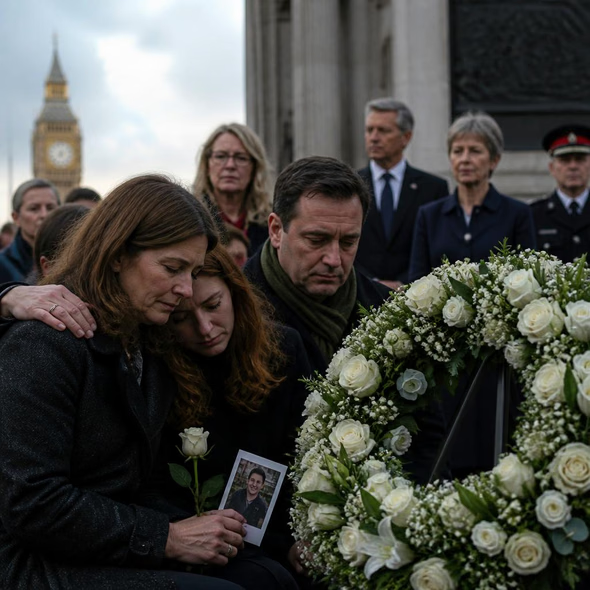
A memorial date can keep survivors within public memory, but ceremony should open a record of obligations rather than close one. The measure of the observance will be whether institutions let survivors define remembrance and sustain care after the wreaths are removed.
The United Kingdom is holding its first national day for victims and survivors of terrorism on Friday. The observance gives official recognition to people injured by attacks, families carrying bereavement and survivors whose lives continue under consequences that public attention often treats as finished. The BBC’s account centers on one survivor who regards the day as an assurance that people like him will not be forgotten.
That assurance matters because an attack occupies two kinds of time. There is the public time of breaking news, investigation, trial and anniversary. Then there is the survivor’s time: treatment, interrupted work, altered relationships, recurring pain and the administrative labor of proving that an old event still has present effects.
Civic calendars have long turned loss into a recurring appointment. They can preserve names and teach people born later why a particular history belongs to them. They can also compress many lives into one ceremony, asking a wreath and a minute of silence to carry experiences that do not fit neatly inside either.
A date is a promise to return. It is not proof that anyone stayed.
If this national day is to become more than an annual expression of sympathy, recognition must travel into ordinary institutions. That means asking whether survivors can obtain appropriate physical and psychological treatment, whether support remains available years after an attack, and whether official procedures recognize injuries that are enduring even when they are not visible.
The ritual must also leave room for difference. Some survivors may welcome public commemoration; others may want privacy, anger, political scrutiny or no assigned performance of resilience at all. A nation can honor survival without turning survivors into evidence of its own strength. The people being remembered should retain authority over what remembrance asks of them.
Friday establishes the date. What follows will establish its weight: who oversees continuing support, how survivors influence future observances, and which practical duties the government attaches to the language of remembrance. Those answers will show whether the calendar marks a living commitment or only an annual return to the scene.
Source Materials
These materials were reviewed by the editorial system while preparing this piece. Muerte.casa may interpret, satirize, reframe, or disagree with them.
- My life was changed by a terror attack - now survivors like me won't be forgotten BBC · August 20, 2026 · Primary signal · Direct source
How did this story land?
This may be changed as you like.