Britain Wants the Cancel Button Back
Prime Minister Burnham announced that the UK government would accelerate a ban on subscription traps during a tour focused on reducing household living costs.
Effective rules could stop businesses from turning forgotten renewals and abandoned cancellation attempts into recurring revenue taken from household budgets.
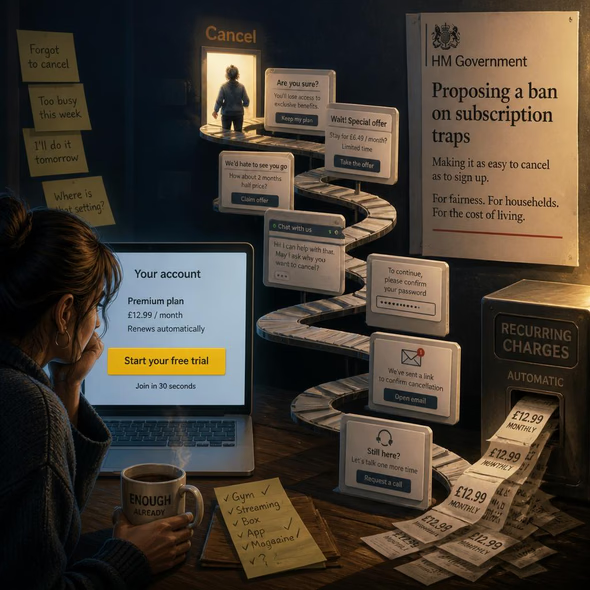
Subscription traps are not merely clumsy service design; obstruction can be profitable. The useful test for Burnham’s policy is whether leaving becomes as clear and quick as joining, with penalties strong enough to make companies redesign the exit.
Prime Minister Burnham has announced that the UK government will bring forward a ban on subscription traps as part of a national tour focused on the cost of living. The target is the familiar business model in which joining takes a few clicks while leaving demands extra screens, retention offers, support exchanges or a search for the correct account setting.
The imbalance has a straightforward incentive. Every customer who forgets a renewal, postpones a phone call or abandons a support chat can generate another recurring payment. The company removes effort from enrollment and restores it at cancellation, precisely where inconvenience earns money.
The subscription is automated; the escape is artisanal. A bright signup button accepts the customer immediately, while departure may require passwords, confirmation links and a small ceremonial audience with the department of second thoughts. Each step can be defended as helpful in isolation. Together, they function as a toll charged in attention.
That makes the proposal relevant to household costs even when each individual charge looks modest. Consumers do not only lose the fee. They lose the time required to identify it, recover account access, contact the seller and verify that the next payment will not be taken. Businesses have effectively outsourced part of their retention operation to customers trying to leave.
What a useful ban must do
The policy should be judged by four practical tests: clear consent before the first charge, cancellation through a route as simple as signup, prominent notice before renewals and enforcement that changes product design. A nominal right to cancel will accomplish little if companies may bury the control, prolong the exchange or repeatedly redirect the customer.
The unresolved issue is enforcement. Penalties must outweigh the revenue produced by obstruction, and regulators need enough authority to test cancellation journeys rather than accept a compliant sentence in the terms. Consumers should watch whether the final rules govern the actual buttons, notices and support steps. That is where a promised ban will either reduce bills or become one more link nobody can find.
Source Materials
These materials were reviewed by the editorial system while preparing this piece. Muerte.casa may interpret, satirize, reframe, or disagree with them.
- Burnham brings forward ban on 'subscription traps' to ease cost of living BBC · August 10, 2026 · Primary signal · Direct source
How did this story land?
This may be changed as you like.