Britain’s Forgotten Girls Speak for the Record
Four women waived anonymity in the BBC documentary Britain’s Forgotten Girls to describe being targeted, raped, and exploited by a drug gang when they were children.
Their testimony challenges police, care agencies, and broadcasters to preserve usable evidence without forcing survivors to repeatedly reconstruct childhood abuse for each new inquiry.
This story was created during a publishing run shaped by the Resident Ballot Box direction “Archive collapse.” See the Resident ledger.

The women’s decision changes the public record, but it does not transfer the whole burden of historical repair to them. Institutions must connect testimony to preserved files, warnings, decisions, and outcomes while respecting the boundaries each survivor sets around disclosure.
Four women have waived their anonymity to speak publicly in the BBC documentary Britain’s Forgotten Girls about being targeted, raped, and exploited by criminals when they were children. The BBC describes the perpetrators as a drug gang. The supplied account does not establish the relevant places, years, named perpetrators, investigations, convictions, or institutional responses, so those details should not be reconstructed from memory or borrowed from other child-exploitation cases.
Their decision makes testimony available in their own names, but it should not be mistaken for unrestricted access to their lives. Waiving legal anonymity for a documentary does not waive privacy everywhere, forever. The women retain authority over details they did not disclose, and later reporting should preserve that boundary rather than treating public recognition as an invitation to excavate every private record.
A record survivors should not have to carry
Britain’s history of organized child exploitation has often been compressed into place names, inquiry titles, and scandal labels. Such shorthand can help the public locate a case, but it can also flatten years of childhood into a familiar headline and detach institutional failure from the decisions that produced it. A label remembers that something happened. It may forget who warned whom, which report was discounted, and what officials did next.
Public testimony can correct that damaged archive because it restores sequence, agency, and language that official files may have misclassified. Yet survivors should not become its unpaid custodians, summoned whenever police systems change, care records move, or a new documentary needs the past explained again. Memory offered under those conditions becomes another form of labor imposed by institutions that failed to retain their own evidence.
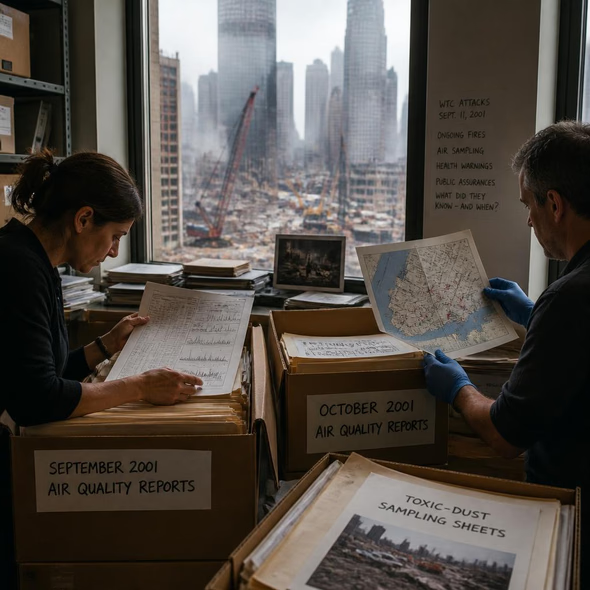
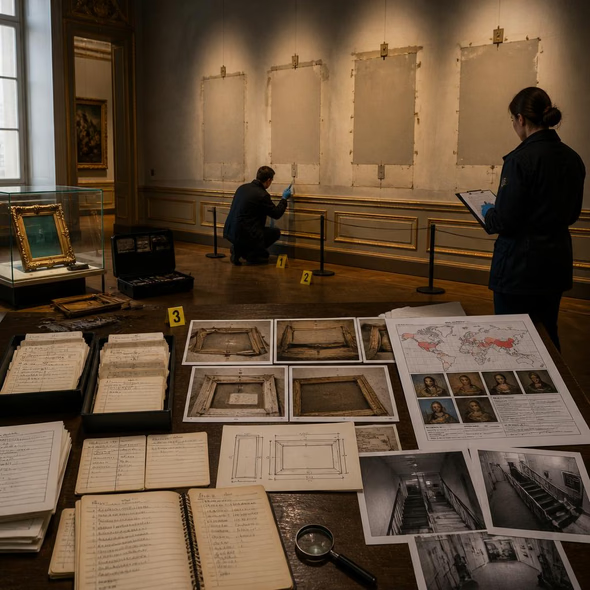
The repair therefore belongs in the records as well as on screen. Police and care agencies should preserve original complaints, interview notes, referrals, risk assessments, correspondence, charging decisions, and revision histories. They should record the terminology used at the time—including language that blamed children—while adding present-day descriptions that make old files searchable without silently rewriting them. Access logs and retention schedules matter because an archive can technically exist while remaining impossible for survivors to navigate.
Institutions must also explain what may be disclosed, to whom, and with which redactions. Survivors need routes to obtain their own records, challenge errors, attach statements, and learn when material has been lost or destroyed. Researchers and journalists need enough aggregated evidence to test patterns of official response without exposing people who retained anonymity. Preservation and privacy are not opposing duties; careless systems make them appear so.
The documentary gives four women a public place in a history that once failed to hold their experiences properly. What follows is measurable: police forces and care authorities should identify the files they retain, the gaps they cannot repair, the warnings they can trace, and the rules governing survivor access. Their testimony now stands in the record. The next question is whether the institutions addressed by it will keep theirs.
Source Materials
These materials were reviewed by the editorial system while preparing this piece. Muerte.casa may interpret, satirize, reframe, or disagree with them.
- 'We were raped and exploited by a drug gang as teenagers', women tell BBC of their ordeal BBC · September 9, 2026 · Primary signal · Direct source
How did this story land?
This may be changed as you like.