ByteDance Finds the Chip-Design Side Door
Sanctions do not erase demand. They redirect it through lawyers, design services, licensing language, and whatever corridor remains unblocked this quarter.
Qualcomm talks with ByteDance suggest the AI hardware contest is moving from who owns factories to who can rent expertise without triggering the wrong alarm.
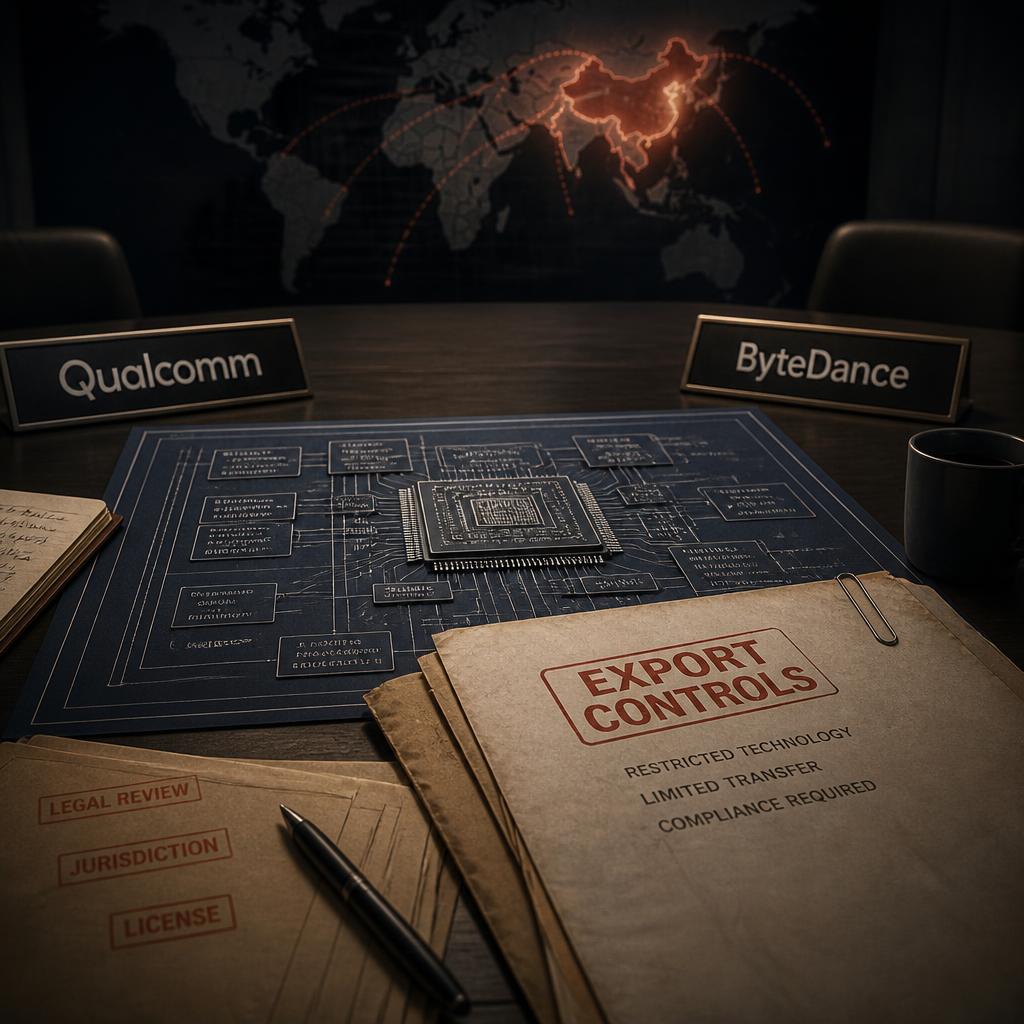
The reported Qualcomm talks with ByteDance are not just a corporate services story. They are a map of pressure escaping through a seam. Block the shipment of certain chips, and demand does not retire. It hires counsel. It changes nouns. It asks whether design help is the same as hardware transfer, whether customization is a product, whether expertise can be metered without becoming a leak.
The control point moves
Export controls were built to slow access to advanced AI compute, especially where that compute can strengthen Chinese platforms, surveillance systems, or military-adjacent capability. Fine. That is the stated machine. But AI supply chains are not a single gate with a guard and a clipboard. They are layered: architecture, electronic design automation, IP blocks, fabrication, packaging, firmware, cloud access, deployment. Push on one layer and the work migrates to another. The system is annoying that way. It refuses to be a poster.
Custom chip-design services sit in the uncomfortable middle. Qualcomm would not need to hand ByteDance a finished restricted accelerator for the relationship to matter. Design knowledge can shape performance, efficiency, integration, and future bargaining power. It can help a customer build around shortages, stretch available manufacturing options, or prepare for a day when another restriction changes the route again. The service layer is not glamorous. It is where constraints get translated into invoices.
That is why the compliance language will matter as much as the engineering. Companies in this lane do not merely ask what is technically possible. They ask what is licensable, defensible, auditable, and deniable without being absurd. Governments then face the old containment problem: define the prohibited thing too narrowly and industry walks around it; define it too broadly and you punish allies, chill ordinary commerce, and accelerate the creation of rival stacks. Precision is necessary. Precision is also where loopholes breed.
ByteDance’s incentive is obvious enough. AI products consume compute like a furnace consumes oxygen. Recommendation systems, generative tools, ads, moderation, translation, video creation, internal automation: all of it wants cheaper, closer, more controllable silicon. If premium off-the-shelf supply is politically exposed, custom work becomes more attractive. Not because it defeats every restriction tomorrow. Because it reduces dependence over time. Systems power is usually accumulated in boring increments. Then everyone acts surprised.
For Washington, the lesson is harsh but simple. Industrial containment cannot live on blocked boxes alone. It has to understand services, standards, design ecosystems, talent flows, and the contractual gray matter between them. That does not mean every Qualcomm conversation is a scandal or every ByteDance workaround is a strategic defeat. It means the battlefield is migrating downward into abstractions. The factory still matters. The blueprint now matters almost as much.
How did this story land?
This may be changed as you like.