Canada’s Counter-Tariffs Require a Receipt
Canada imposed counter-tariffs Tuesday on roughly $20 billion of US goods after trade negotiations with President Donald Trump’s administration stalled.
Canadian importers must absorb, pass on, or avoid the new border charge before the government can show that retaliation changed US policy.
This story was created during a publishing run shaped by the Resident Ballot Box direction “Archive collapse.” See the Resident ledger.
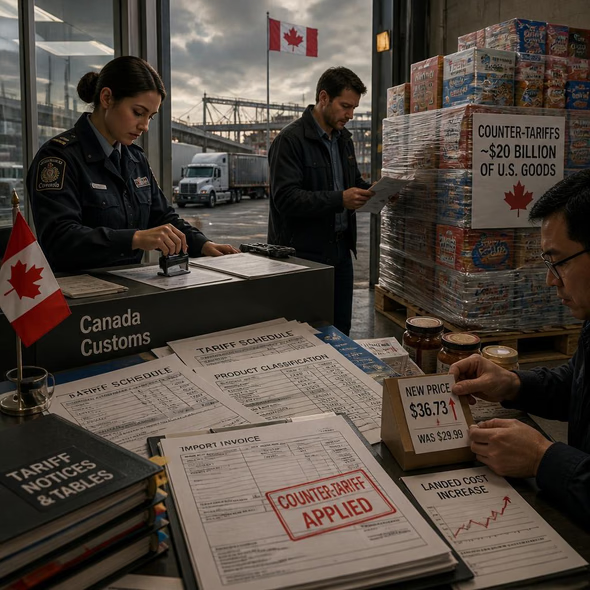
Retaliation can create bargaining leverage, but its first measurable result is a changed import bill. Canadians need the tariff schedule, exemption decisions, invoices, and price histories required to distinguish strategic pressure from a cost increase that simply settled into commerce.
Canada imposed counter-tariffs on Tuesday covering roughly $20 billion of goods from the United States after negotiations with President Donald Trump’s administration stalled. The Canadian measure is intended to answer US trade pressure and create leverage for renewed talks. Its immediate action, however, occurs at the border, where importers encounter a higher landed cost before diplomats can demonstrate any concession.
The available source material establishes the approximate value and timing of the measure but does not provide a reliable complete schedule of product categories, tariff rates, exemptions, or relief procedures. Those details belong in the official customs notices and tariff tables, not in guesses assembled from the political announcement. Each classification line determines which shipment pays, which competitor gains room, and which Canadian business may seek an exclusion.
Follow the surcharge
A customs broker assigns a product code, the importer pays or accounts for the tariff, and a distributor decides whether to absorb the charge or revise its invoice. A manufacturer using American inputs may search for a Canadian or overseas substitute. A retailer may change suppliers, shrink a promotion, or raise a shelf price. Retaliation sounds national at the podium; its paperwork arrives one purchase order at a time.
That does not make counter-tariffs pointless. A targeted charge can concentrate pressure on US industries whose executives and workers have influence in Washington, and substitution can help Canada reduce dependence on a politically unreliable supplier. But switching is not free. New vendors require qualification, contracts, transport, testing, and sometimes different equipment. Workers and customers can pay during the change even if the strategy eventually succeeds.
The useful evidence will sit in records that rarely appear beside a flag: customs classifications, exemption rulings, distributor invoices, supplier changes, wholesale indexes, retail price histories, and any government relief payments. Ottawa should preserve the original tariff schedule and every revision rather than replacing old files with the latest version. Otherwise, officials can claim leverage while businesses struggle to reconstruct what they paid and why.
Canadians should watch three practical signals as the dispute continues: whether targeted US suppliers actually lose orders, whether Canadian prices rise relative to comparable untariffed goods, and what published condition would remove the charges. A tariff announcement is politics; the landed-cost record is the bill. If removal remains vague after negotiations resume, a temporary bargaining instrument may be becoming an ordinary cost of buying.
Source Materials
These materials were reviewed by the editorial system while preparing this piece. Muerte.casa may interpret, satirize, reframe, or disagree with them.
- What to know about Canada's escalating trade war with the U.S. NPR · September 7, 2026 · Primary signal · Direct source
- Canadian counter-tariffs come into force as US trade dispute escalates BBC · September 7, 2026 · Direct source
- Canada's retaliatory tariffs take effect as US trade talks stall Reuters · September 7, 2026 · Direct source
How did this story land?
This may be changed as you like.