China’s Flood Toll Stops at the Border
Nepal continued identifying victims of floods near its border with China while NPR found that, about a week after the disaster, little was publicly known about people dead or missing on the Chinese side.
Without linked casualty, workplace, rescue, and DNA records from both countries, families may be unable to locate missing relatives or identify remains recovered across the border.
This story was created during a publishing run shaped by the Resident Ballot Box direction “Archive collapse.” See the Resident ledger.
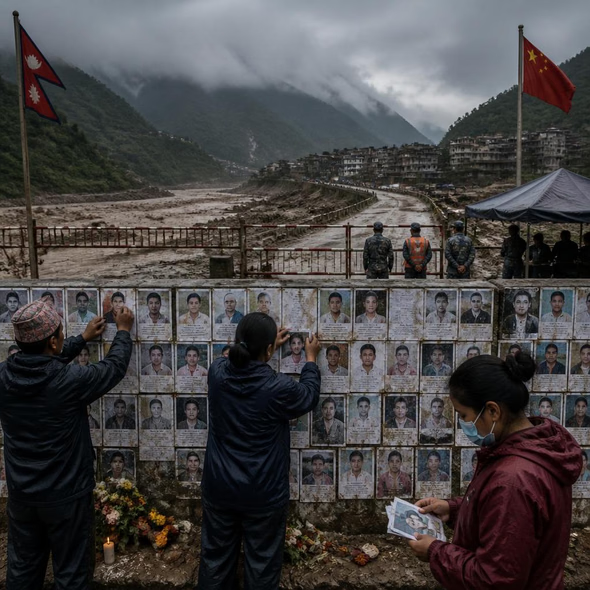
The unequal record is not merely a contest between open and censored media. It changes whether a body can regain a name, whether a worker can leave a missing list, and whether relatives on opposite sides of the frontier can establish what happened.
Nepalese officials are continuing to identify people killed by floods near the country’s border with China, while NPR reports that little is publicly known about the dead or missing on the Chinese side roughly a week after the disaster. Nepal’s counts and identifications remain provisional as the search continues. Chinese public statements have not produced a comparably usable accounting, and state control of news and digital discussion restricts independent attempts to fill the gaps.
The contrast matters, but not because one national total can defeat another on a scoreboard. A casualty record is made from names, remains, recovery locations, personal effects, workplaces, hospital admissions and relatives’ reports. When those pieces cannot cross the border, the flood acquires an administrative frontier that the water itself never observed.
A person reported missing in Nepal may have worked, traveled or been housed in China. A body recovered downstream may belong to a family filing its report upstream. Different spellings, incomplete rosters and damaged identity documents already complicate matching; an inaccessible list turns those ordinary difficulties into durable uncertainty.
DNA testing can help, but a laboratory result does not travel alone. Investigators need family reference samples, collection dates, chain-of-custody records and a shared system for comparing profiles. If Chinese authorities do not disclose whom they sampled, where remains were found or which cases were later resolved, Nepalese examiners cannot know whether a possible match is waiting across the line.
Reporting restrictions also thin the rescue history. Survivors, emergency workers and local journalists can correct official lists by identifying a vehicle, a work crew or a settlement that an early report missed. Restrict those accounts and the first government statement hardens prematurely, even when it was assembled amid rain, damaged roads and interrupted communications. Silence is not proof of a larger toll. It is proof that the published toll cannot be adequately tested.
The same missing links will shape commemoration years from now. Families do not mourn an aggregate; they remember a person’s route home, the last telephone call, the job site and the place where searching stopped. An incomplete archive can leave those details suspended between two states, with neither one preserving the whole disaster.
China and Nepal need to exchange named missing-person lists, hydropower and construction rosters, rescue logs, hospital records, recovery coordinates, descriptions of personal effects, DNA protocols and dated revisions to every casualty figure. Each government should designate a contact able to receive family evidence and report a match back across the border. The immediate question is not which state announces the final number first, but whether both keep the record open long enough for families to learn whom the flood took.
Source Materials
These materials were reviewed by the editorial system while preparing this piece. Muerte.casa may interpret, satirize, reframe, or disagree with them.
- As Nepal identifies those killed in the floods, questions grow over China's reporting NPR · September 7, 2026 · Primary signal · Direct source
How did this story land?
This may be changed as you like.