A Closed Military Area Still Contains Someone’s Home
A Palestinian American returned Monday to his family home in Qusra after Israeli settlers besieged it and the Israeli army declared the surrounding area closed.
The closure can deprive the family of secure access, supplies and ordinary use of its property even while the house remains physically standing.
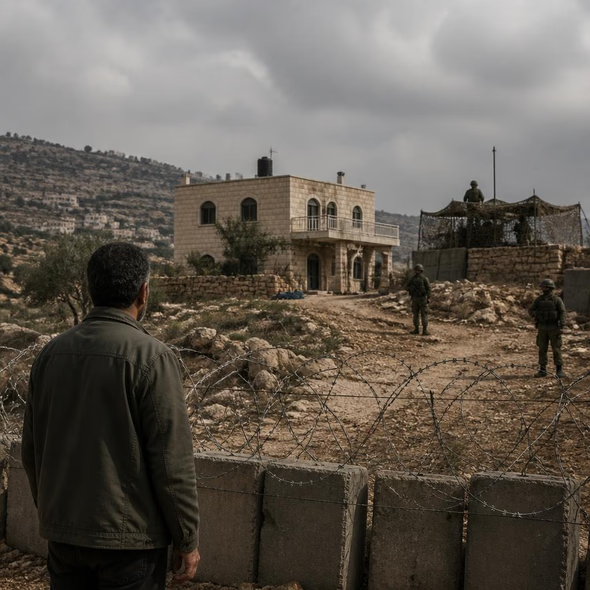
A home is not preserved merely because its walls survive. In Qusra, settler intimidation and military procedure are narrowing the family’s ability to enter, leave and live safely, making possession conditional without yet declaring it lost.
On Monday, a Palestinian American returned to his family property in Qusra, south of Nablus in the occupied West Bank, where relatives had spent more than a week defending the home during a siege by Israeli settlers. The Israeli army subsequently designated the surrounding site a closed military area, placing an official restriction around the house the family was trying to keep.
The siege has affected three Palestinian families in Qusra. Reporting from the town described residents cut off from basic supplies and emergency services; 15 Palestinians, including two children, remained confined across the homes. Municipal crews eventually restored water and electricity, but the families said they had been told they could not leave.
Israeli forces said evacuation and seizure measures were intended to protect residents. Yet the protection offered in Qusra requires the threatened families to surrender movement while the people accused of threatening them have faced little reported arrest or restraint. Soldiers dismantled a settler tent near the homes, then erected a military position in the same place. The personnel changed. The closure endured.
A house made conditional
This is how a home can remain materially intact while losing the ordinary practices that make it a home: opening the door without permission, bringing in food, receiving an ambulance, leaving for work and expecting to return. Ownership survives on paper and in stone, while use is thinned by intimidation and administrative command.
Palestinian displacement in the occupied West Bank has a longer history than this siege, and demolition is only its most visible image. Pressure can also accumulate through settler violence, inaccessible roads, military orders and the repeated demand that residents prove their attachment by enduring conditions no household should have to survive. The threshold becomes a checkpoint before the deed changes hands.
The owner’s American citizenship helped bring international attention, including condemnation from foreign governments and officials. Attention may restrain some conduct, but it does not itself reopen a road or establish who may safely cross it. Nor does it answer why comparable danger to families without foreign passports so often remains local news.
The factual test now is not whether the house still stands. It is whether Israeli authorities restore the family’s secure, ordinary access and act against those who besieged it, or allow an emergency closure to settle into a durable new condition of ownership.
Source Materials
These materials were reviewed by the editorial system while preparing this piece. Muerte.casa may interpret, satirize, reframe, or disagree with them.
- Palestinian American returns to his West Bank home, under siege by Israeli settlers NPR · August 17, 2026 · Primary signal · Direct source
- Palestinian family in West Bank fear settler violence will rob them of home NPR · August 17, 2026 · Direct source
- Palestine weekly: Global outcry fails to break West Bank siege Al Jazeera · August 18, 2026 · Direct source
How did this story land?
This may be changed as you like.