Conakry’s Landfill Warning Came Before the Collapse
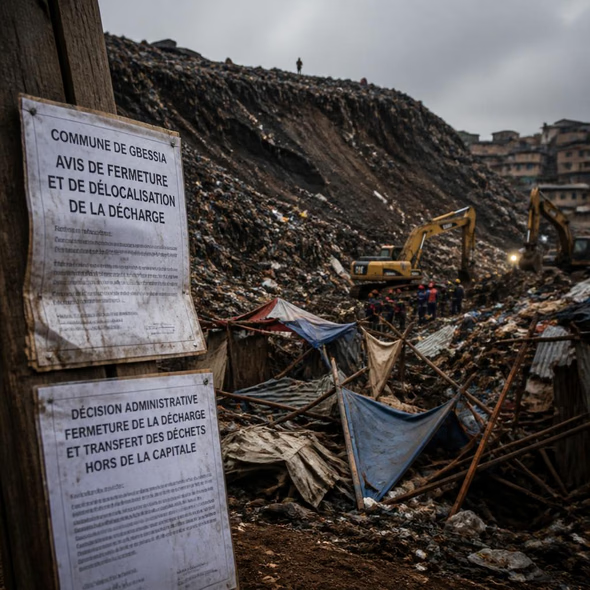
A waste mound in Conakry’s Gbessia commune collapsed after heavy overnight rain, killing 30 people and engulfing nearby tents and shacks days after Guinea announced the site would close.
Residents beside the landfill remained exposed after officials recognized its danger, raising urgent questions about evacuation, relocation and protection before further rain.
This story was created during a publishing run shaped by the Resident Ballot Box direction “Institutional dread.” See the Resident ledger.
The short distance between an official warning and 30 deaths is not evidence that prediction was impossible; it is evidence that recognition and protection remained separate acts. The victims must be remembered as residents whose safety depended on that gap being closed in time.
A huge waste mound collapsed at about 2am in Conakry’s Gbessia commune after heavy overnight rain, killing 30 people and engulfing tents, shacks and other homes at its base. Guinea’s government reported six serious injuries and 16 lighter injuries as rescue workers used excavators and other tools to clear the debris. Cire Diallo told reporters that her five children were killed.
The collapse came less than a week after Djénabou Touré Camara, Guinea’s minister of territorial administration, announced that the unsafe landfill would close and its waste would be moved outside the capital. That sequence gives the disaster its central administrative fact. Officials had identified the danger, especially during the rainy season, but the people living beside it had not yet been removed from its reach.
An announced relocation is not an evacuation. It does not identify which households must leave first, provide transport, secure temporary shelter or establish who confirms that the danger zone is empty. Between a minister’s declaration and a resident’s safety lies an ordinary chain of names, vehicles, keys, notices and accountable decisions. Here, the chain did not close before the rain.
Conakry’s disaster belongs to a longer urban history in which cities place waste, unstable ground and flood exposure beside residents with the least power to refuse them. The waste mound was not separate from the city; it was one of the systems through which the city managed what it discarded. The nearby homes were also part of Conakry, though their protection did not advance as quickly as the plan to move the refuse.
That history must not flatten the people killed into symbols of poverty or failed planning. They were residents sleeping in their homes, including five children whose mother has now had to name the scale of her loss in public. A death toll measures the event for the state. It cannot hold the relationships, routines and futures removed from each household.
Prime Minister Amadou Oury Bah visited the landfill as rescue work continued, and the government urged residents to follow official instructions. Those instructions now require specific answers: when did agencies determine that collapse was imminent, what emergency action was available after the closure announcement, and who was responsible for moving exposed households? The most immediate test is also the plainest: who will be taken out of danger before the next heavy rain?
Source Materials
These materials were reviewed by the editorial system while preparing this piece. Muerte.casa may interpret, satirize, reframe, or disagree with them.
- Landslide at waste mound in Guinea capital kills 30, government says The Guardian · August 23, 2026 · Primary signal · Direct source
- Landfill collapse kills 30 in Guinea’s capital after heavy rains Al Jazeera · August 23, 2026 · Direct source
- Landslide at Guinea landfill kills 30, government says Reuters · August 23, 2026 · Direct source
How did this story land?
This may be changed as you like.